
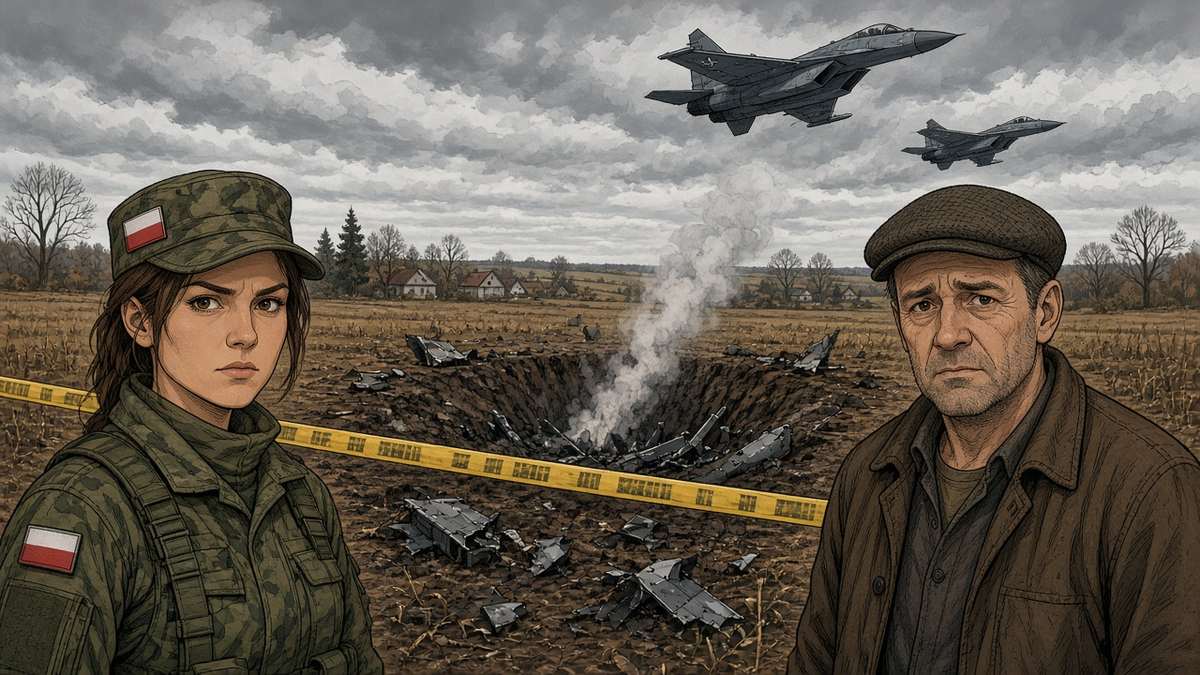
NATO ambassadors gathered in Brussels on Monday for an emergency session of the North Atlantic Council, three days after a trio of Russian aerial objects crossed into Poland and crashed in the country’s southeast. Poland’s delegation, headed by Paweł Zalewski, the number two at the defence ministry, arrived with one clear request: concrete measures to harden the alliance’s eastern frontier.
The incursion happened before dawn on Friday, while Moscow was pounding western Ukraine in one of its heavier raids. Two of them fell in Podkarpackie province, the third in the Lublin area, and no injuries were reported. Prosecutors in Lublin have identified the debris recovered outside Nowy Lipowiec as a Russian Kh-101, and that the weapon was manufactured as recently as the final quarter of 2026. Its warhead went off in mid-air, scattering fragments over a wide area. What fell at the remaining two sites is thought to be another missile plus a drone driven by a jet engine.
One detail has raised eyebrows. A Swedish Gripen pilot on patrol over Poland had permission to fire on the incoming weapon but never pulled the trigger, because poor weather made it impossible to confirm the target visually or with onboard sensors.
For Donald Tusk, the head of government, it was an “intentional provocation”. His defence chief, Władysław Kosiniak-Kamysz, expects “strong support” from partners, and NATO chief Mark Rutte flew to Warsaw on Saturday, promising that commanders would pinpoint weak spots in the alliance’s defences.
The incident also dominated the alliance’s parliamentary gathering in the German capital, where Johann Wadephul, Berlin’s top diplomat, pledged to defend “every centimeter” of allied territory. Poland is far from the only target of such incidents: Romania and the three Baltic states have reported similar intrusions, and Finland said over the weekend that a Russian military helicopter had apparently strayed into its airspace.
