
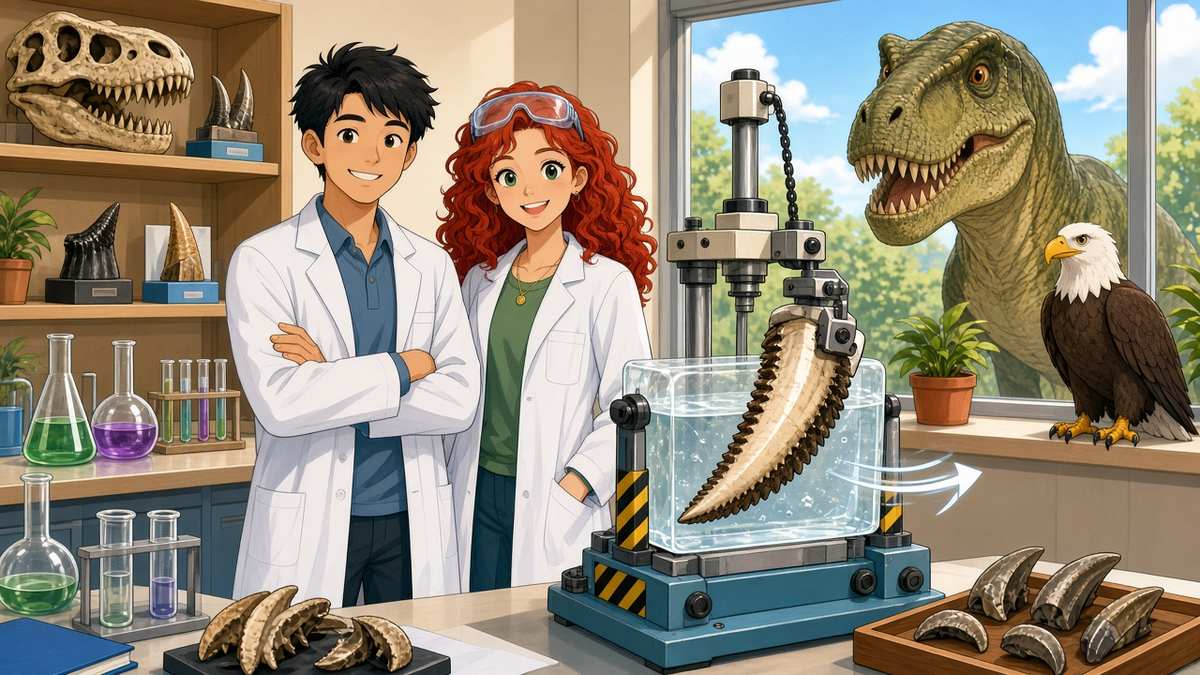
Forget the image of a predator slamming its jaws shut like a bear trap. A lab experiment suggests that meat-eating dinosaurs did most of their cutting by hauling their teeth back toward the throat, the way a cook draws a serrated knife across a loaf.
Manabu Sakamoto, a palaeobiologist at Reading in England, teamed up with Illinois evolutionary biologist Philip Anderson to build a test rig they called DinoSAW. It drove a replica Allosaurus tooth into ballistics gel, a stand-in for animal tissue, either straight down or along a diagonal path angled backwards, while sensors logged the force.
The backward stroke won clearly. Dragging the tooth back took around 14 newtons of peak force on average, while pushing it straight in took 21.4, so the saw-like stroke saved about a third of the effort. Filming the gel under polarised light showed why: a straight bite produced sharp hotspots of stress, while the pulling motion spread the load more evenly.
Tooth shape explains the gap. Theropod teeth curve backwards and carry serrations on both the front and rear edges. Pressed straight down, mostly the front edge does any work. Pulled back, the tooth follows its own curve and both cutting edges engage.
The authors argue that the animals likely sank their teeth in and then hauled back with powerful S-shaped necks, much as eagles and other birds of prey, themselves living theropods, tear at a carcass today. Komodo dragons, with similar teeth, feed the same way, and fossil bite marks often look like grooves rather than punctures. The study, in the journal Palaeontology, also argues against an older idea of a separate bite followed by a pull. Sakamoto says models of dinosaur skulls should consider “the direction of the bite, not just its strength”.
