
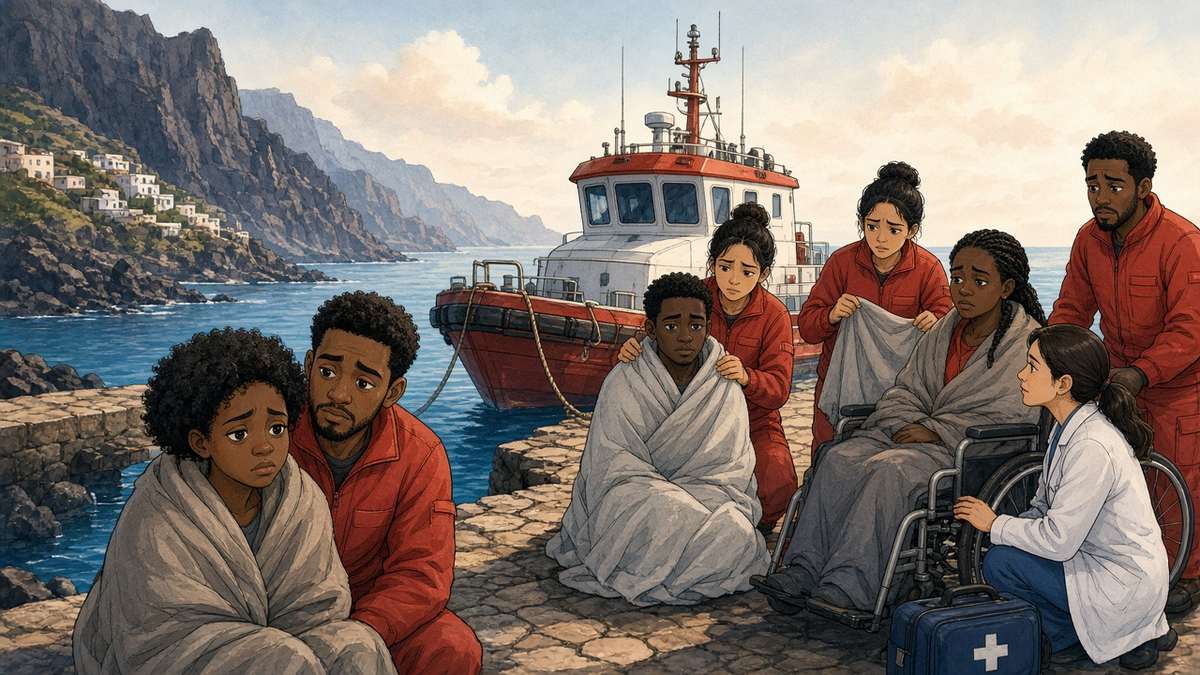
The first sign of trouble came from a passing sailboat. In the early hours of Friday its crew alerted Spain’s maritime rescue centre in Tenerife to a wooden boat drifting about 72 kilometres south of El Hierro, the smallest of the populated Canary Islands. By the time rescuers reached it, 14 of the people on board had died.
Survivors said the vessel had set out from Banjul, the Gambian capital, ten days earlier. Medics described severe dehydration and hypothermia among those who made it. Six people in serious condition – one woman and five men – were flown by helicopter to the island’s hospital. Another 84, among them three women and three minors, were taken to the port of La Restinga, where several had to be carried ashore on stretchers or in wheelchairs because they could no longer stand.
One man refused to leave the dead behind and stayed on the boat as a Guardia Civil patrol vessel towed it to harbour, where the bodies were brought ashore on Friday afternoon. An officer was injured during the operation, and the rescue service has arranged psychological support for its crews after what it called a deeply emotional emergency.
The tragedy comes amid a sharp rise in arrivals. As coastguards in Senegal, Mauritania and Morocco have stepped up surveillance, smugglers now launch boats from Gambia, Guinea and Guinea-Bissau, adding days to a crossing that was already one of the deadliest on earth. Earlier this week about 2,100 people reached the archipelago in a single day, most of them landing on El Hierro, an island of 11,400 residents that has declared an emergency.
Canary Islands leader Fernando Clavijo voiced “a lot of pain” and a sense of powerlessness, urging Madrid and the European Commission to act in West Africa. Spaniards vote in a snap parliamentary election on Sunday, and how to handle arrivals has been among the hottest topics of the campaign.
