
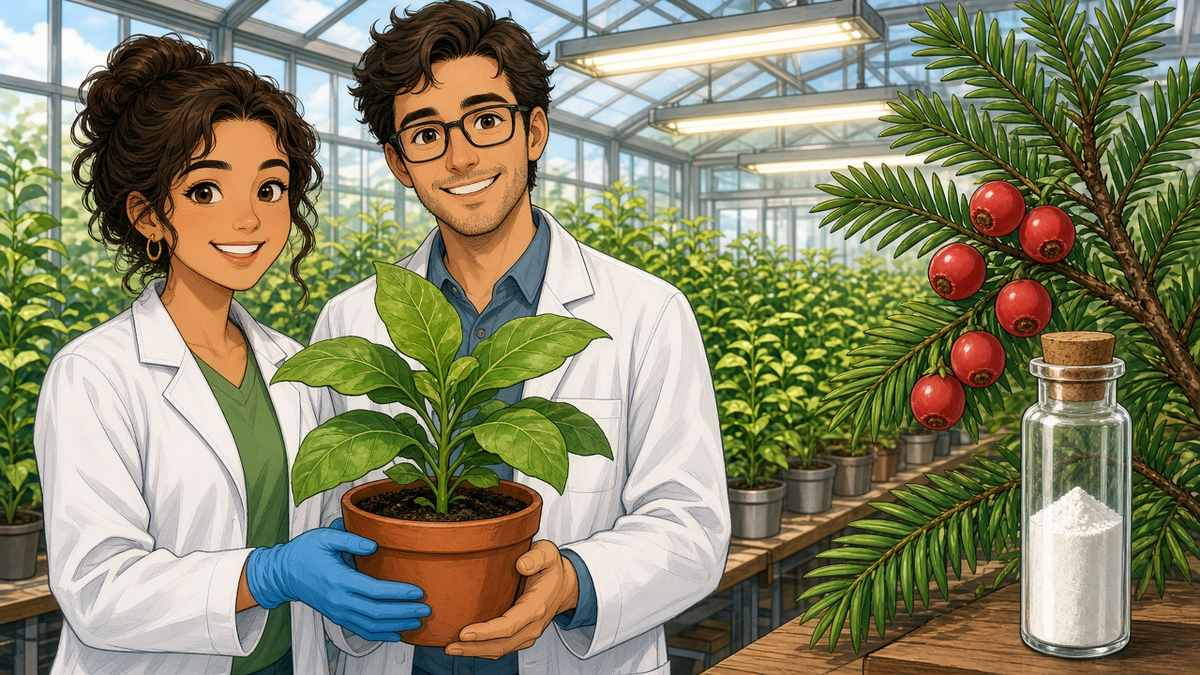
One of chemotherapy’s most important drugs has finally given up its secrets. Researchers at the University of Copenhagen have pieced together every step yew trees use to make paclitaxel, the breast, ovarian and lung cancer treatment sold as Taxol, and then rebuilt that entire chain inside a fast-growing relative of tobacco.
Biochemist Sotirios Kampranis and his colleagues moved more than 20 yew genes into Nicotiana benthamiana, a workhorse plant of lab biology. Rather than assuming how the missing reactions worked, they tested the rival theories for each unresolved step, pulled out intermediate molecules and confirmed where each one sits in the sequence. The study appeared in Nature Chemical Biology and was spotlighted by Nature this week.
The output is what turns heads. After targeted tweaks, the engineered plants made more than 500 times as much of the drug as at the start, reaching just over 61 micrograms per gram of dried leaf, a level similar to what yew bark contains naturally.
That matters because Taxol is costly to produce today. Manufacturers rely on yew cell cultures or on chemically converting plant-derived precursors, routes that are slow, inefficient and hard on scarce trees. A biological factory could eventually make the medicine cheaper and easier to supply around the world.
For now it is a proof of concept. The yew genes were introduced only temporarily into the leaves, so the plants have to be treated again for every batch. Kampranis calls permanent integration into the plant’s genome “the next major challenge,” a prerequisite for greenhouse-scale output. With the blueprint in hand, his team also sees promise in fermenting the drug in yeast.
