
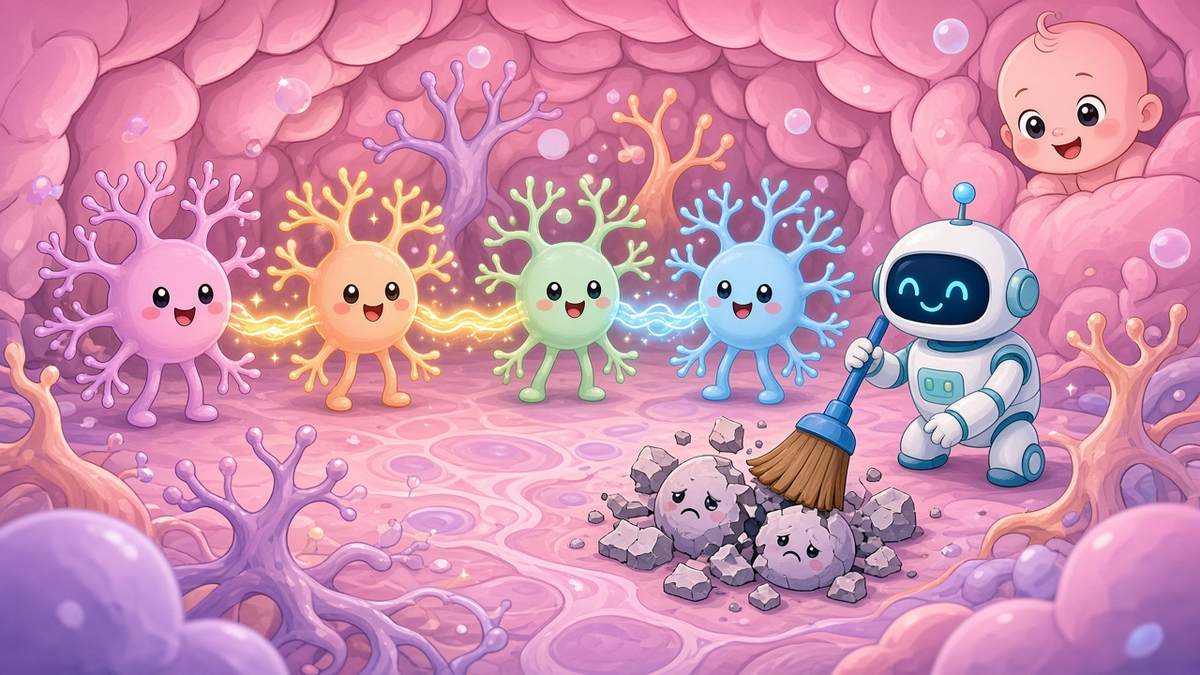
Long before a baby takes its first breath, its brain has started throwing things away. A study published on Wednesday in Nature suggests that around birth the human cortex removes a huge share of nerve cells whose DNA has gone wrong, a clean-out that may run into the billions of cells.
The team, led by paediatric neurogeneticist Diane Shao of Boston Children’s Hospital, sequenced more than 2,300 individual neurons from fetal and infant brains. In the fetal samples, roughly 26 percent of cells carried large chromosomal errors, with whole stretches of genetic material either missing or duplicated. In samples taken after birth, only around six or seven percent did. Something, in other words, had weeded out most of the faulty cells in a short window around delivery.
The survivors were not a random group. Neurons that kept their place were less likely than expected to carry changes in genes that are sensitive to dosage or linked to neurodevelopmental disease. The researchers think the filter is tied to synapse formation, the stage when neurons wire up with their neighbours, so cells that cannot connect properly may simply be culled.
Independent experts are intrigued. UCL neurologist Christos Proukakis, who had no role in the research, reads the data as a sign that the brain keeps the neurons whose DNA stayed in the best shape. Shao describes it as a newly recognised way of setting both the number and the quality of neurons a person ends up with.
The finding could matter for medicine. Neurons with abnormal genomes are suspected of contributing to conditions that tend to surface in childhood, including autism spectrum disorders. Learning when this quality check succeeds, and why it sometimes might fail, could help explain those conditions, although the researchers stress that much basic work still lies ahead.
