
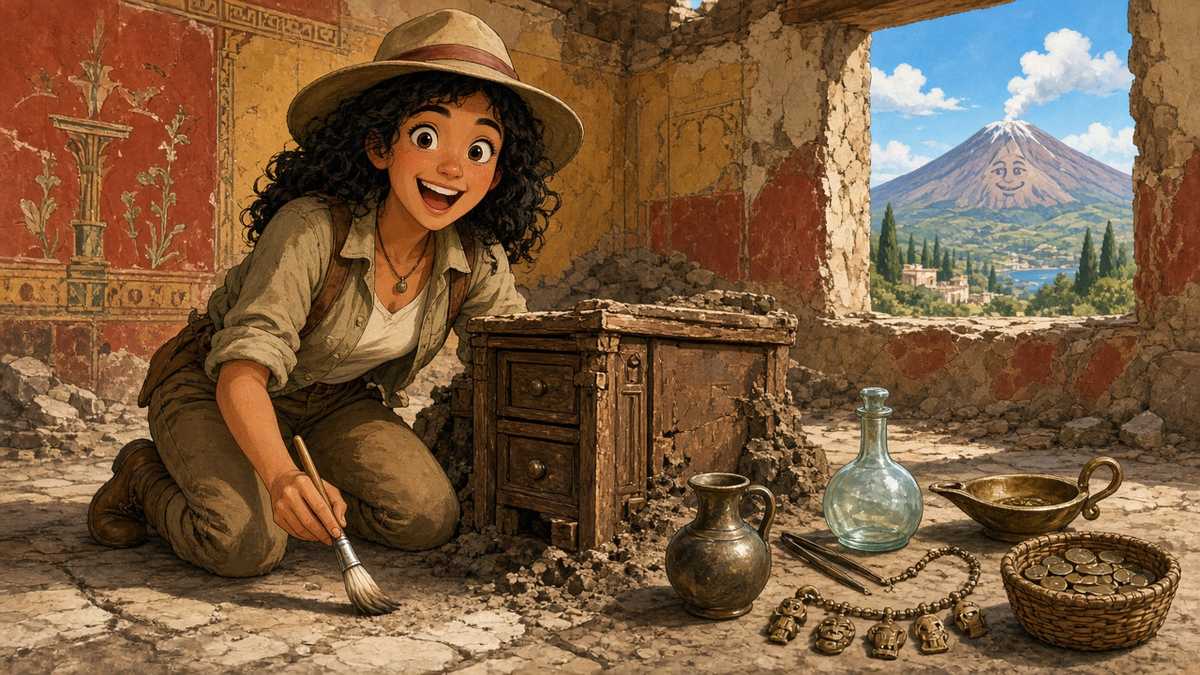
Nearly two thousand years after Vesuvius buried it, a wooden cupboard in Pompeii has given up its contents, and they read like a page from someone’s private diary. Archaeologists recovering the interior of the cabinet found beauty tools, a scent burner, household jugs, a necklace of tiny charms and a little stash of 38 bronze coins.
The cupboard stood in a home in the heart of the ancient city, known as house IX 11, 7. Based on inscriptions that can no longer be read, it has been loosely linked to a man called Cornelius Maximus. Its street front was dug out back in 1912, but the rooms behind were only explored now, as part of restoration work on the neighbouring block known as the Insula of the Chaste Lovers.
The make-up kit included tweezers and a little paddle for mixing colours, joined by a glass flask for ointment and a bronze oil lamp. A set of lead weights, once stored in a tiny box of which barely a trace survives, hints that someone living there ran a business. A delicate jug decorated with a pine-scale pattern sat alongside bronze, glass and pottery vessels.
The most touching object is a string of at least two dozen miniature pendants made of faience, bone, coloured glass and quartz, showing gods such as Bes and Mercury as well as hands, feet, pine cones and grapes. The Romans called such strings crepundia. Children wore them for protection, and many adults kept theirs as a memento, a habit that made sense in a mobile empire where people often lived far from home.
The coins, stored in a woven basket, suggest the owners left in a hurry or never got the chance to come back. Gabriel Zuchtriegel, who runs the archaeological park, admits nobody can be sure who the resident was. Still, he argues, such humble finds restore “the human dimension of the past”.
The refined frescoes decorating that space point to a comfortable household, even though building work appears to have been under way when the eruption struck.
