
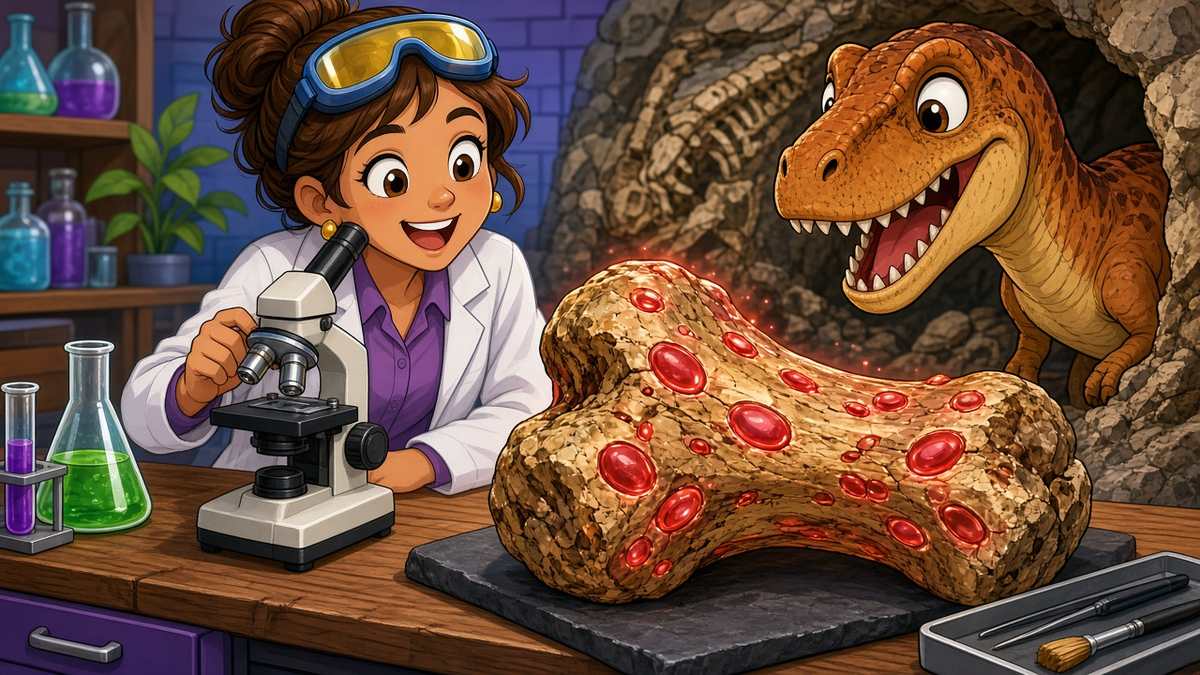
Hidden in the bone channels of a small predatory dinosaur from north-eastern Brazil, researchers say they have found something most of their colleagues thought could never survive deep time: the remains of red blood cells, still holding chemical remnants of the compound that once ferried oxygen around the animal’s body.
The animal is Aratasaurus museunacionali, a theropod roughly three metres long that lived about 115 million years ago in what is now the Romualdo Formation, a site famous for unusually detailed fossils. The team, led by organic geochemist Kliti Grice of Curtin University in Australia, reported the result on Monday in the US journal PNAS.
Their case rests on two pillars. Under the microscope, tiny rounded objects turn up only inside the narrow channels that once held the animal’s vessels, not in the surrounding rock. Chemically, the bone is rich in heme, the iron-bearing core of haemoglobin, and in altered forms of it, while the microbial mat that buried the carcass is dominated by chlorophyll-type compounds. That contrast, the authors argue, makes contamination unlikely. They believe a manganese oxide called hausmannite coated the cells and acted as a natural preservative.
Sceptics are not yet sold. Mary Schweitzer, a molecular palaeontologist in North Carolina who has spent years on dinosaur soft tissue, credits the group with careful work. Yet she remains “not convinced” that what the pictures show are blood cells. Bird and reptile blood cells keep a nucleus that produces a visible bulge, she noted, and these structures have none; their size is also off. Other experts would like more tests to rule out different sources of heme.
Whatever the verdict, the paper pushes an old question back into the spotlight: how much of an extinct animal’s biology can a fossil really hold on to?
