
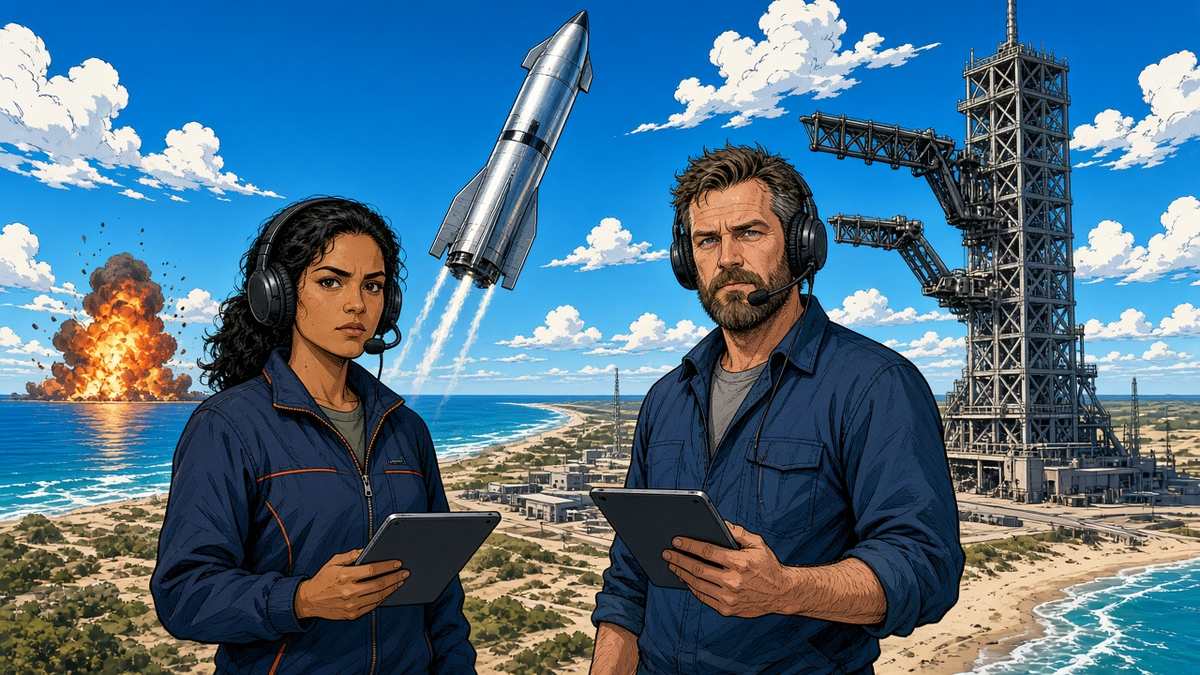
SpaceX’s latest Starship test is only half finished, and the more daring half comes on Saturday. The rocket lifted off from the company’s Starbase site near the Mexican border shortly before 5 p.m. on Friday, Texas time, and the 33 Raptor engines of the Super Heavy first stage carried the stack cleanly through ascent and stage separation.
The booster was then supposed to fly home and be grabbed by the launch tower’s mechanical arms roughly six and a half minutes into the mission. Instead, for reasons SpaceX has not explained, it was steered away and brought down in the Gulf of Mexico, where it exploded in a blast visible to spectators miles away. The company has caught three first-generation boosters in the past but has yet to recover the new Version 3 design.
The upper stage, Ship 42, had a far better evening. It settled into a low orbit around 275 kilometres up, only the second time a Starship has done so after September’s Flight 14, and then released 26 third-generation Starlink satellites. SpaceX says the batch adds about a terabit of capacity to its internet network. Three of the satellites carry cameras aimed back at the ship to inspect its heat-shield tiles, a long-standing weak point of the programme.
Those pictures feed into the real headline attempt. After circling the planet up to 14 times, the ship is meant to return to Starbase on Saturday afternoon, around 3:15 p.m. Texas time, and be caught by the tower, something SpaceX has never tried with an upper stage. Because the approach crosses Mexico and southern Texas, it will only go ahead if every check on the vehicle’s health is passed; otherwise the ship will be ditched in the ocean off Hawaii or Chile.
A successful catch would move Elon Musk’s company a big step closer to a rocket that can be flown again and again.
