
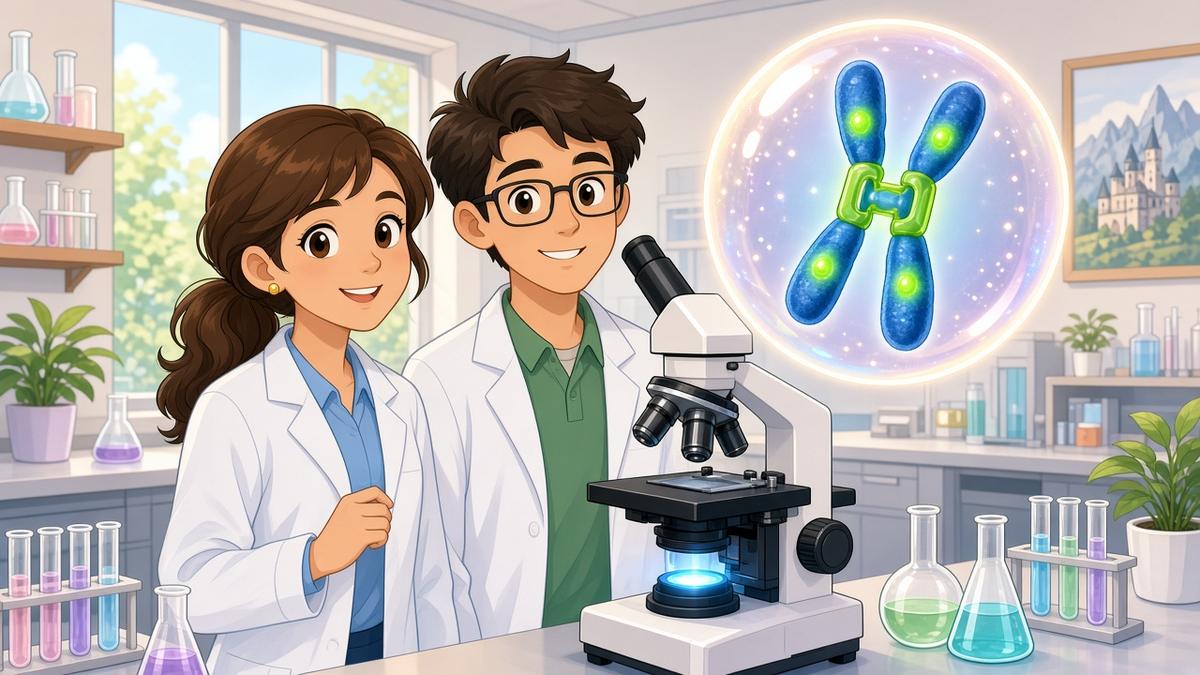
Part of the reason fertility falls in a woman’s late thirties lies inside the egg itself. Every egg is formed before birth, so by middle age it has been waiting for decades. Over that time it gradually loses cohesin, the ring-like protein complex that ties the two halves of each chromosome together. Without enough of it, the halves can drift apart before the egg divides, leaving it with surplus or missing chromosomes. Embryos made from such eggs rarely implant, which is also a major reason IVF fails more often in older patients.
Melina Schuh, who heads a department at a Max Planck institute in Göttingen, and her group set out to find a stand-in for that lost tether. Their answer, reported in Science on Thursday, is an engineered system called TALhesin: two programmable DNA-binding proteins that latch onto a stretch near the centromere and then lock onto each other, holding the sister chromatids in place.
In eggs from aged mice the substitute made a clear difference. The share of eggs with no premature splitting rose from 46.7 to 74.1 per cent, almost matching young animals. A built-in cut site proved just as important: separase, the enzyme the egg already uses to snip natural cohesin at the right moment, also releases TALhesin, so the chromosomes still part when they are supposed to.
The researchers then tried a human-adapted version on unfertilised eggs donated through clinics in Göttingen, Berlin and Cambridgeshire. The proteins bound where intended, and chromosomes coated with more of them showed tighter chromatid pairs. Schuh called it the first time lost cohesion has been replaced.
Big questions remain. The system has not yet been tested on eggs from older women, and nobody knows whether it would lead to more pregnancies. The team says extensive safety work must come before any use in fertility clinics.
