
Most earthquakes are far too weak for anyone to notice, and seismologists have generally treated the small ones as simple events: a single patch of fault slips, and the break spreads evenly evenly in every direction. New research in the journal Science suggests that picture leaves a lot out.
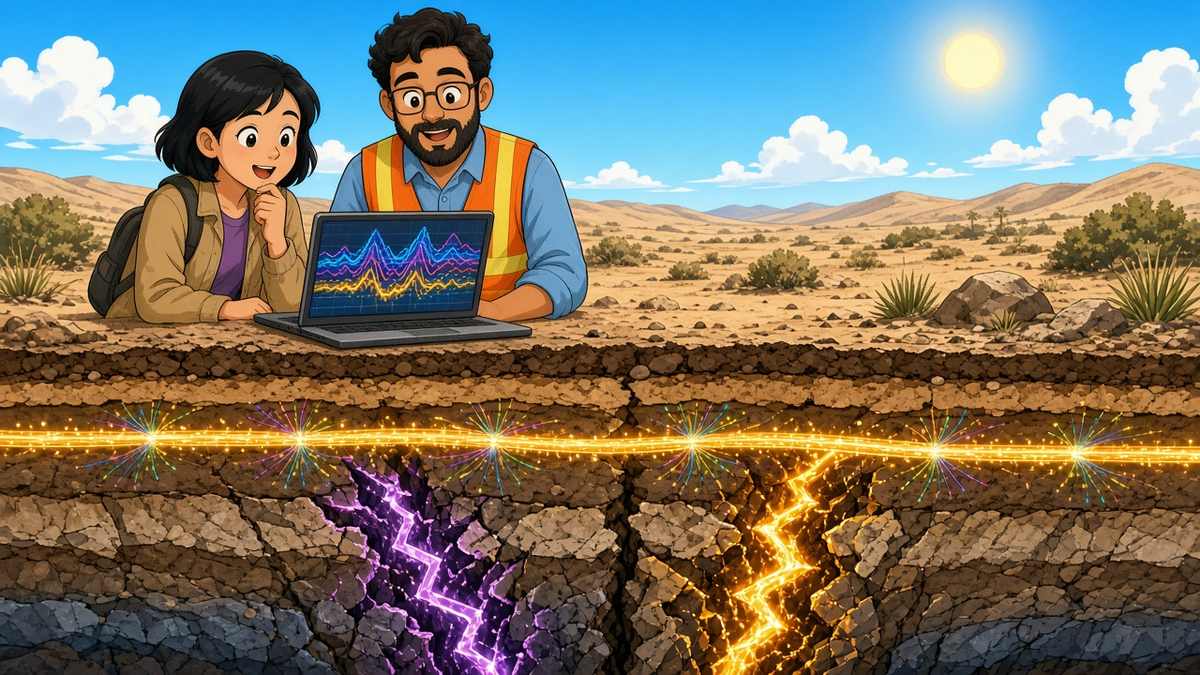
Rather than relying on a handful of distant seismometers, an international team turned an ordinary buried telecom line into a sensor. The trick, known as DAS, sends laser pulses down a glass fibre; when passing seismic waves stretch or squeeze the cable by tiny amounts, the light coming back changes. Used on a 28-kilometre stretch crossing the quake-prone Brawley area close to the Salton Sea, where the great San Andreas network of faults fizzles out, the technique yielded roughly 7,000 measuring points, one every four metres.
The scientists, with Korean geophysicist YoungHee Kim and her Houston-based colleague Jonathan Ajo-Franklin in charge, zoomed in on a quake of magnitude two recorded during the spring of 2021. Instead of one smooth slip, they saw two separate ruptures on neighbouring parts of the fault. Barely 42 milliseconds separated the onset of one from the other. Each patch reached up to roughly 150 metres across; the two met at an edge without overlapping. According to Kim, the earlier break most likely set off the later one.
Fragmented ruptures of this kind had been documented in bigger quakes in the area, where the slower pace makes them easier to follow. Finding the same behaviour at such a small scale could sharpen models of how stress jumps from one section of a fault to another. Because fibre networks already run beneath many cities and highways, the researchers see a low-cost way to watch faults in far finer detail than before.
