
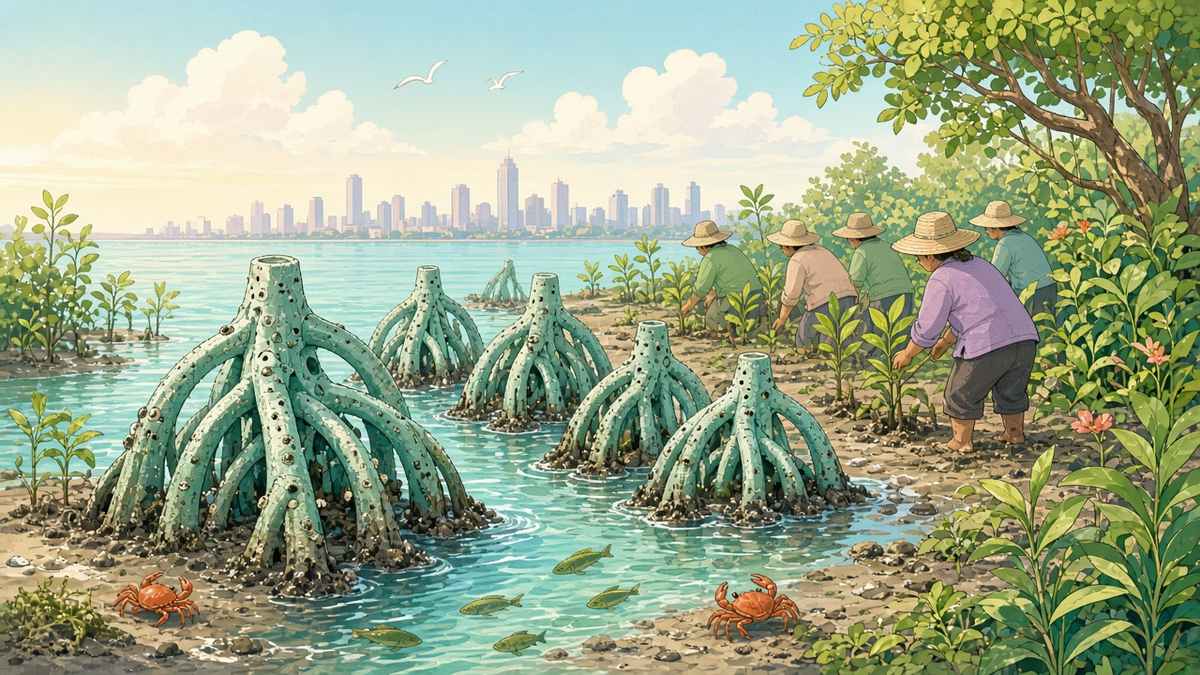
On one of Thailand’s hungriest shorelines, engineers have planted a forest that never grew. Rows of wood-plastic “roots” now stand in the Chao Phraya mud, and early monitoring says they are doing what bamboo fences and rushed replanting often fail to do: hold the silt.
Across eleven trial plots in Samut Prakan’s Phra Samut Chedi district, teams recorded mud banks building up behind ten of the arrays — anywhere from roughly half a foot to nearly three feet. Untreated stretches nearby kept shedding land by more than ten metres. Here the sea usually claims tens of metres each year as rising water, sinking ground and upstream dams starve the delta of fresh mud.
Why this shape?
Each unit copies the job of living mangrove roots — slowing waves, stirring water just enough for particles to drop — rather than matching their look. Modules spanning tens of metres can be fixed in two to four weeks with local materials. Shrimp growers told workshops that waves eased enough to rebuild dikes; one landowner restarted planting where more than twenty hectares had vanished over two decades.
Scientists refuse to sell a miracle. The system needs silt already in the water to capture; deeper, high-energy spots underperformed. Outside experts call it a scaffold at best — useful until living mangroves take over — and want years of checks so composites do not become marine litter.
Still, other Thai provinces are already testing the design, and Indonesia has shown interest. For families watching fields collapse overnight, speed matters more than purity: something that can stand before the next storm, not after the next study.
