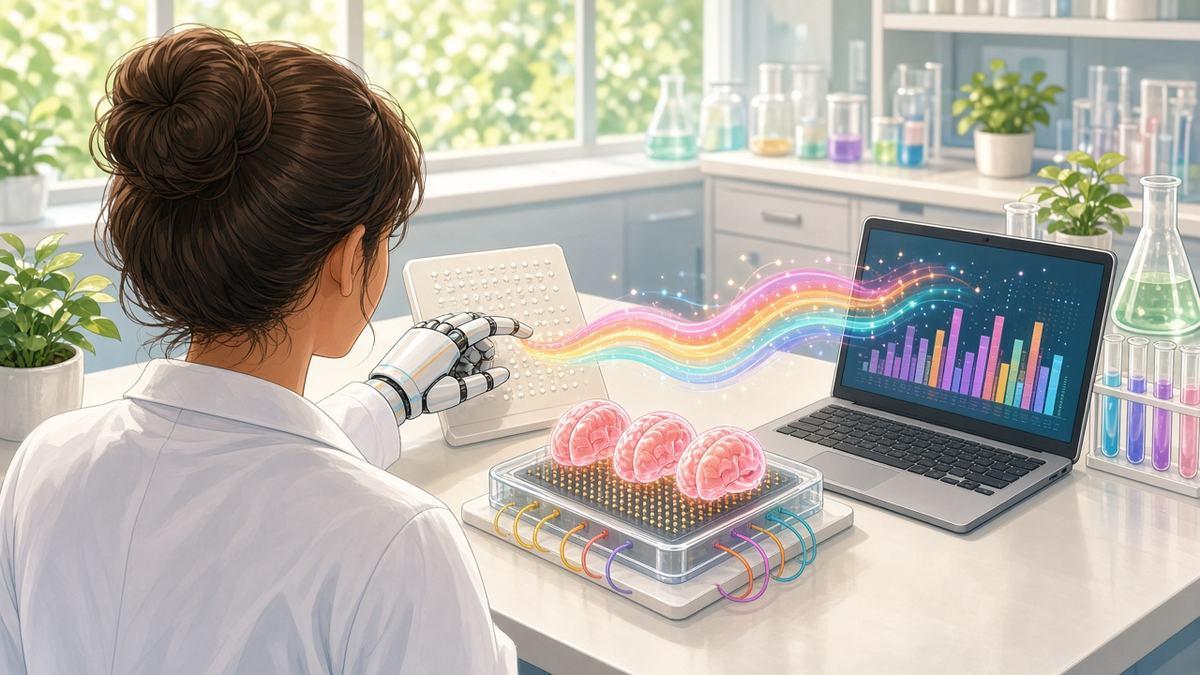
Can a speck of living brain tissue help a machine read by touch? Engineers in Bristol have taken a small step in that direction. In a paper released on 16 October in Frontiers in Artificial Intelligence, they report that human brain organoids can relay touch signals for all 26 Braille letters in a way a computer can still interpret.
Organoids are clusters of cells grown from stem cells that mimic parts of the brain. The ones used here measure less than a millimetre and contain around 10,000 neurons, but lack much of the structure of a real brain. The team kept them alive on plates studded with electrodes, which let them deliver electrical pulses and record the response.
The experiment worked like a relay race. A tactile sensor first brushed over each Braille character. Its readings were translated into stimulation patterns and fed to the organoids. A basic machine learning classifier then tried to guess the letter from the neural activity that came back. With a single organoid the guess was right about 61 percent of the time; pooling three of them raised accuracy to 83 percent.
The trio also coped better when the researchers deliberately buried the signals in noise. The classifier working directly on the noisy data was fooled more easily than the one reading the organoid output. Why the group does better is unclear; first author Tianyi Liu suspects small differences between organoids give complementary information.
The authors are careful about limits. The tissue did not learn anything, and only one fixed task was tested. Their wish list includes surfaces of different roughness and, later, experiments where the tissue receives a response to its own output. The long-term hope is computing hardware that uses far less energy than silicon chips.