
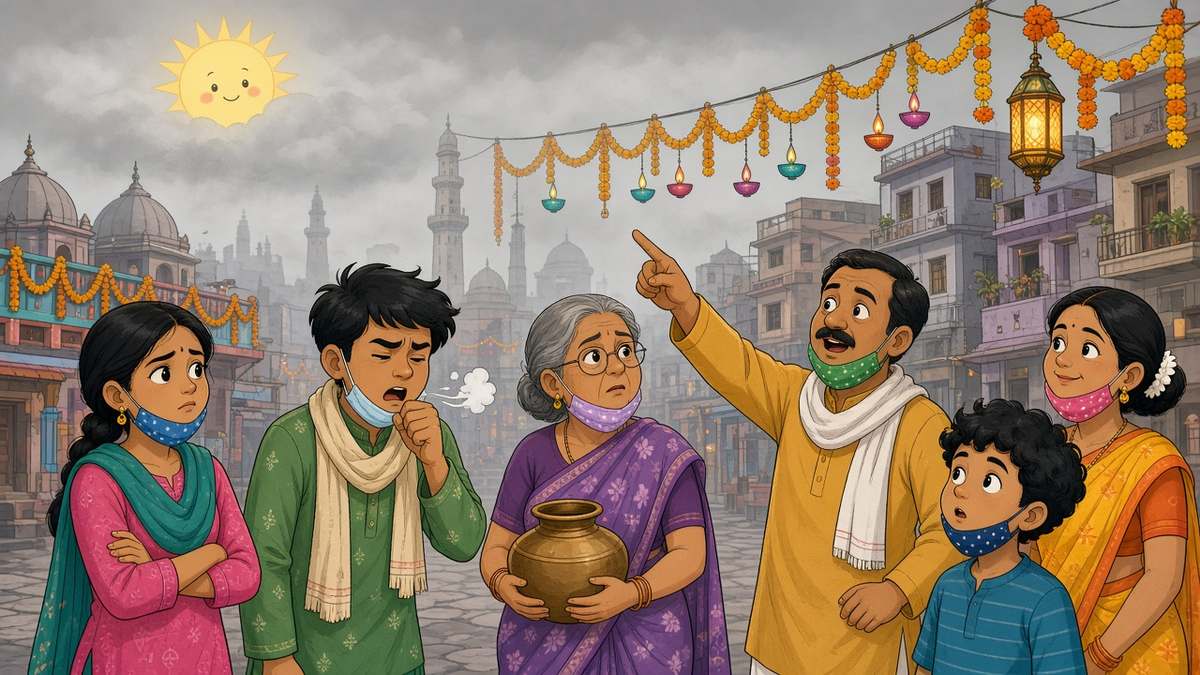
India’s capital woke up on Monday to a sky the colour of ash. A day after Diwali, a dense haze cut visibility across Delhi, and the city-wide Air Quality Index stood at roughly 370 in the early hours, just short of the “severe” band that starts at 401.
Many neighbourhoods were already past that line. Fifteen locations crossed the 400 mark, going by figures carried by India Today, and Sonia Vihar fared worst of all on 449, narrowly ahead of a neighbourhood junction in the north on 445. The festival night itself had been worse in places: 20 of 59 stations hit the severe range, and The Hindu reported that fine-particle PM2.5 concentrations briefly ran 66-fold higher than the daily limit recommended by the WHO.
Fireworks were a big part of the problem. The Supreme Court had allowed only approved “green” crackers this year, limited their use to a set window ending at 10 p.m., and ordered the full ban to return on Monday. Residents in many districts kept celebrating long after the cut-off. Vehicle exhaust, crop-stubble fires in neighbouring states and very light winds, which leave pollutants hanging over the city, did the rest. The official early warning system expects air quality to stay severe for the next few days, and the weather office also issued a dense fog alert.
The capital region is still under the third tier of its emergency anti-pollution scheme, known as GRAP, which curbs building work and keeps some older vehicles off the roads. The smog has once again turned into a political fight. Opposition MP Manoj Jha accused the authorities of treating pollution as a seasonal headline, predicting that interest would fade with the first rains and that “the same questions will return” next autumn. Mumbai and Chennai also reported smoggy mornings after the holiday.
