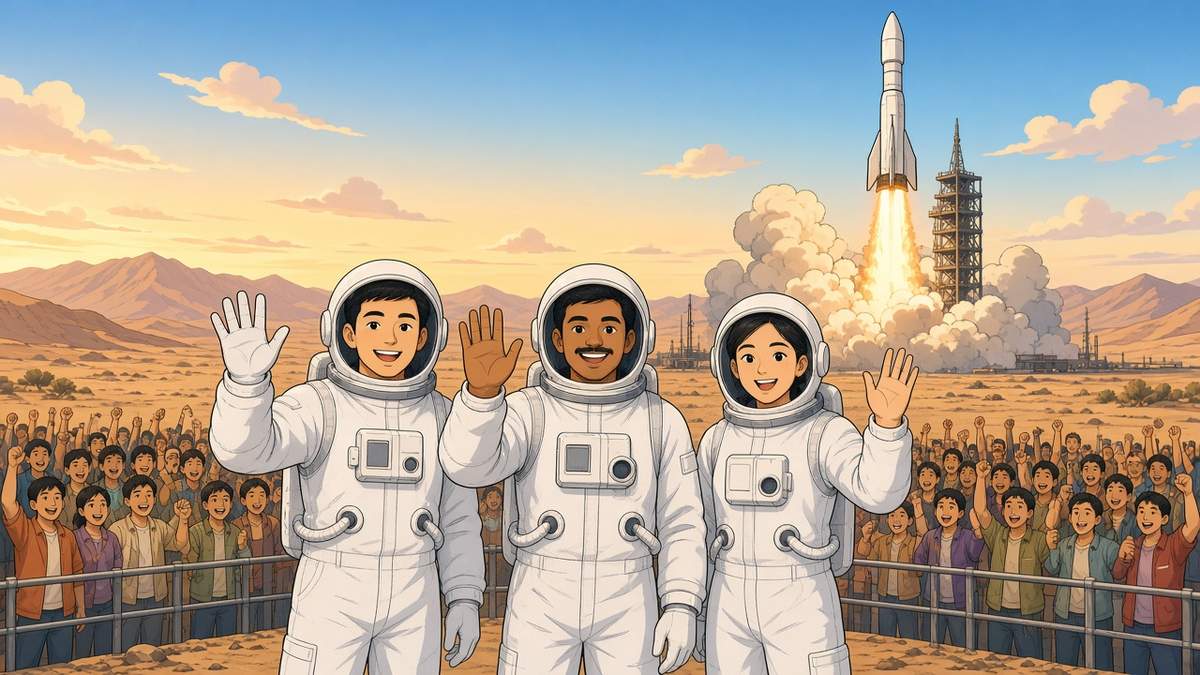
China’s orbiting outpost has its first foreign guest. Shenzhou-24 rose from the Jiuquan launch centre in the Gobi desert at 8:18 a.m. Beijing time on Wednesday, and sharing the cabin with mission chief Tang Hongbo and his colleague Wu Yi was Muhammad Zeeshan Ali, a former Pakistani fighter pilot who became the first non-Chinese crew member ever to fly on one of Beijing’s crewed missions.
About ten minutes after lift-off the capsule separated from its Long March-2F rocket and settled into orbit. The China Manned Space Agency quickly called the launch “a complete success”, and a few hours later the spacecraft docked with the Tiangong station.
Ali made clear what the trip means at home. He said he was carrying “the hopes of 250 million Pakistanis”. Learning Chinese, he told Pakistani media, was among the hardest parts of his preparation in China, where he and fellow finalist Khurram Dawood trained under Chinese instructors before he got the seat.
His research list is compact: how bacteria perform photosynthesis in orbit, and what radiation and weightlessness do to seeds. The wider crew programme covers aerospace medicine, combustion, biology and the way spaceflight affects ageing blood vessels, work that could feed into treatments for vascular disease.
The Pakistani’s stay will be short. He will ride home with two Shenzhou-23 astronauts who have been aboard since May, while Tang and Wu settle in for six months with Zhu Yangzhu, who remains from the previous crew.
Beyond the science, the flight is a statement. The two countries are marking 75 years of space cooperation, and Beijing wants Tiangong seen as an international laboratory rather than a national preserve, a pitch aimed squarely at partners looking for an alternative to US-led programmes. For Pakistan, which has no crewed spacecraft of its own, the invitation opens a door that was otherwise closed. China, meanwhile, is working towards putting its own astronauts on the Moon by 2030.