
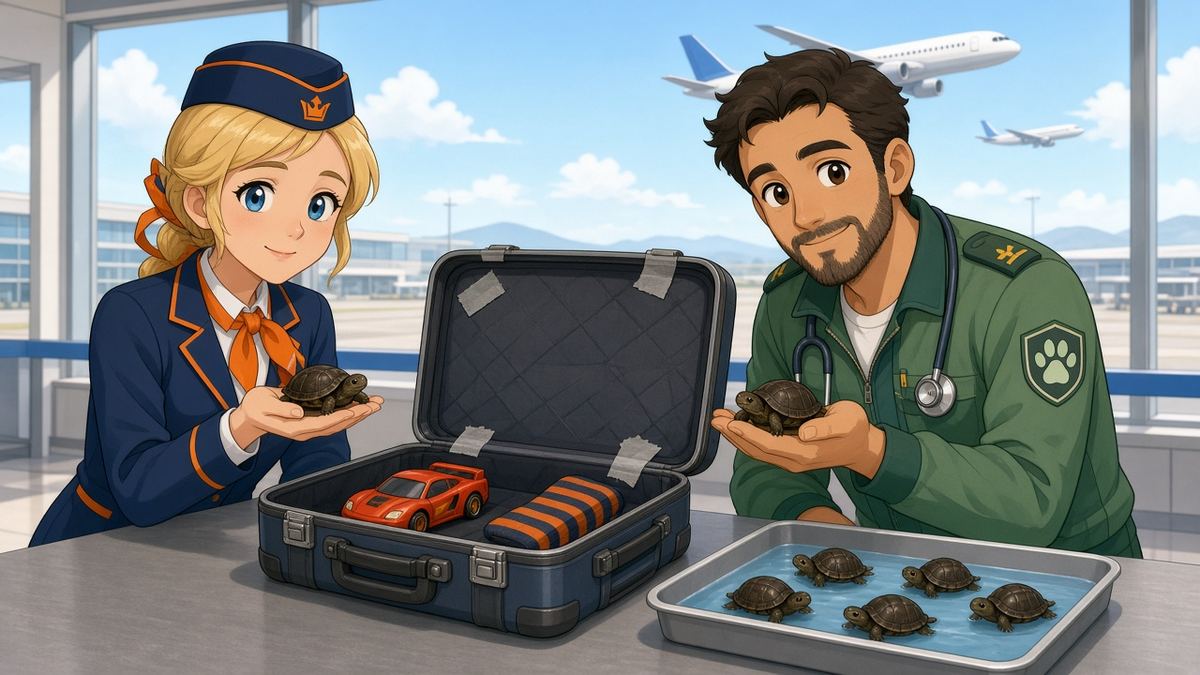
If the estimates are right, a single suitcase at Amsterdam’s Schiphol airport held almost a tenth of a species. Dutch authorities said on Friday that customs officers had pulled 26 Vallarta mud turtles out of a traveller’s checked luggage, an animal believed to number only about 300 in the wild.
The find dates back to 21 November. The passenger had flown in from Mexico and was due to continue to Hong Kong. Because the cargo was alive, customs handed the case to the Dutch food and product safety watchdog NVWA, and military police detained the traveller. He is still in custody while prosecutors oversee the investigation.
The way the reptiles travelled was grim. Most were crammed into a box next to a toy car, the rest stuffed into a closed sock, and every one had been bound in duct tape so it could not move. Remarkably, all of them survived. Staff at a specialist shelter have since peeled the tape off and are nursing the animals.
Kinosternon vogti, as scientists call it, was only formally described in 2018. Adults rarely exceed about ten centimetres, and the species clings to a tiny patch of western Mexico in the state of Jalisco, where urban sprawl and tourism have swallowed nearly all of its habitat. Conservationists list the turtle on the IUCN Red List in its most alarming category, and the CITES treaty grants it maximum protection, which outlaws commercial cross-border sales.
That rarity is exactly what drives the smuggling. Conservation news site Mongabay has reported prices of 10,000 dollars or more per turtle on black markets in Asia, and Hong Kong customs have intercepted several turtle shipments this year. If the seized animals were indeed taken from the wild, the NVWA warned, the remaining population may have shrunk by close to ten percent.
