
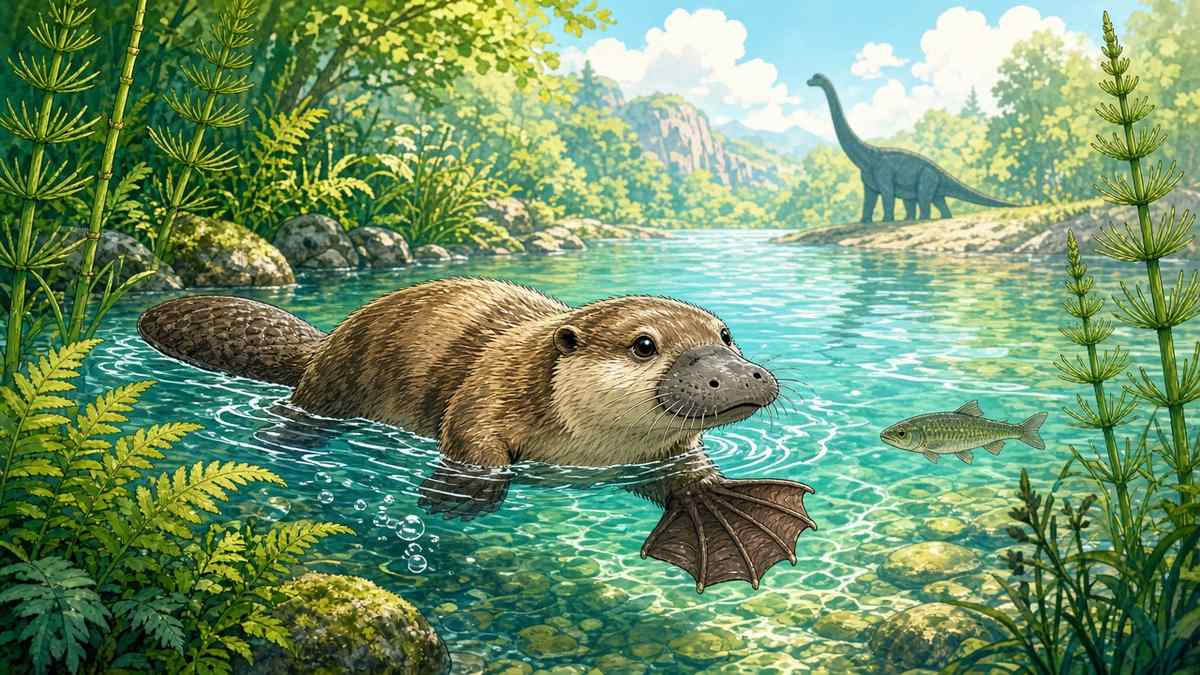
Long before the first true mammals nursed their young, at least one of their cousins may already have had the throat to do it. That is the conclusion of a study in Nature describing Megacauda sungei, a creature that roamed northern China’s Inner Mongolia region roughly 165 million years ago whose name means “big tail”.
The animal belonged to the docodonts, an extinct branch of mammal relatives that lived alongside dinosaurs. It was strikingly odd: a flat, otter-style tail and long-toed hind feet resembling a platypus, plus shearing cheek teeth reminiscent of a seal. Measuring 40 to 50 centimetres and weighing up to two kilograms, it is the largest mammaliaform known from the Jurassic. The researchers picture it denning on land and diving into rivers or lakes to catch fish, salamanders and invertebrates.
What makes the specimen special, though, is its throat. Soft tissue rarely fossilises, so scientists have struggled to pin down when the muscular machinery for suckling and controlled swallowing appeared. Megacauda preserves the delicate hyoid bones and a pair of tiny bony hooks on the palate, features otherwise typical of marsupials and placental mammals. In living species they anchor the muscles that let a baby drink milk and an adult move one chewed mouthful at a time into the gullet. Peishu Li, now at Ohio University and one of the paper’s authors, likens the setup to what an opossum has today.
Senior author Zhe-Xi Luo of the University of Chicago sees efficient swallowing as a pivotal step, because it later freed mammals to evolve specialised teeth for every kind of diet. To see inside, the rock had to be cut up and each piece run through a CT scanner. Their result also overturns an old idea: the modern hooks sat alongside older bony ridges in the same animal, so one probably did not simply evolve into the other.
