
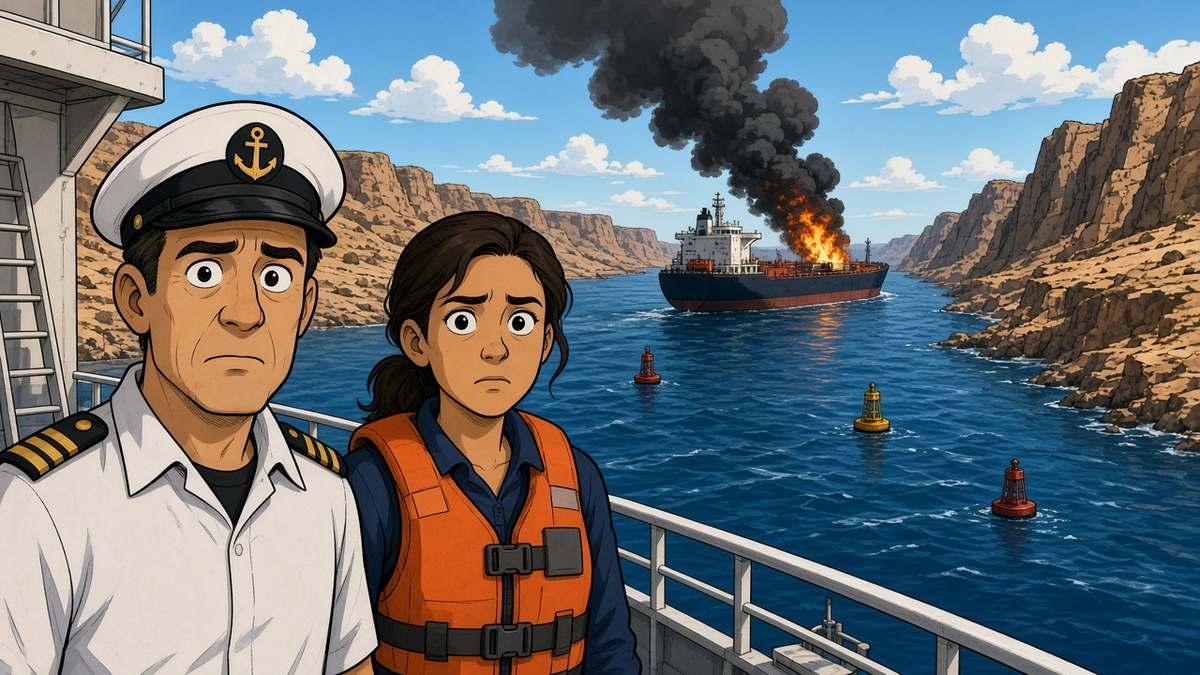
Saturday brought another day of burning ships to the world’s most important oil chokepoint. According to statements from Iran’s regular navy and the Revolutionary Guards, three oil tankers hit sea mines in the narrow waterway over the course of the day and caught fire. Tehran did not identify the vessels or say where they were registered, and the claims could not be independently checked.
The first incident was reported in the morning. According to the regular navy, the vessel had gone dark by switching off its transponder and wandered into a closed zone east of the channel before an explosion left it dead in the water. Later the Guards said two more ships had been running without radar along an unapproved route in the south of the channel when they blew up. The Guards described one as a very large crude carrier.
The backdrop is the conflict that began in February with US and Israeli strikes; ever since, Iran has treated the passage as its own toll gate, insisting on prior approval and targeting ships that ignore it. Washington has answered with a naval blockade of Iranian ports and armed escorts for tankers, and American commanders insist the principal lanes are now free of mines. Iran keeps reporting blasts anyway; on Friday the Guards released video of a liquefied gas carrier sending up a tall column of smoke.
The human cost is spreading far beyond the Gulf. A UN official warned that pricier fertiliser and disrupted shipping have pushed 45 million people worldwide closer to hunger. Separately, the American military reported bringing down a pair of Iranian drones, adding that nobody was hurt.
There are hints of a softer line in Washington. Secretary of State Marco Rubio argued that further strikes are unnecessary because Iran’s economy is already badly weakened, and Iran is set to be discussed when Donald Trump meets Xi Jinping and Vladimir Putin in Shenzhen on November 19.
