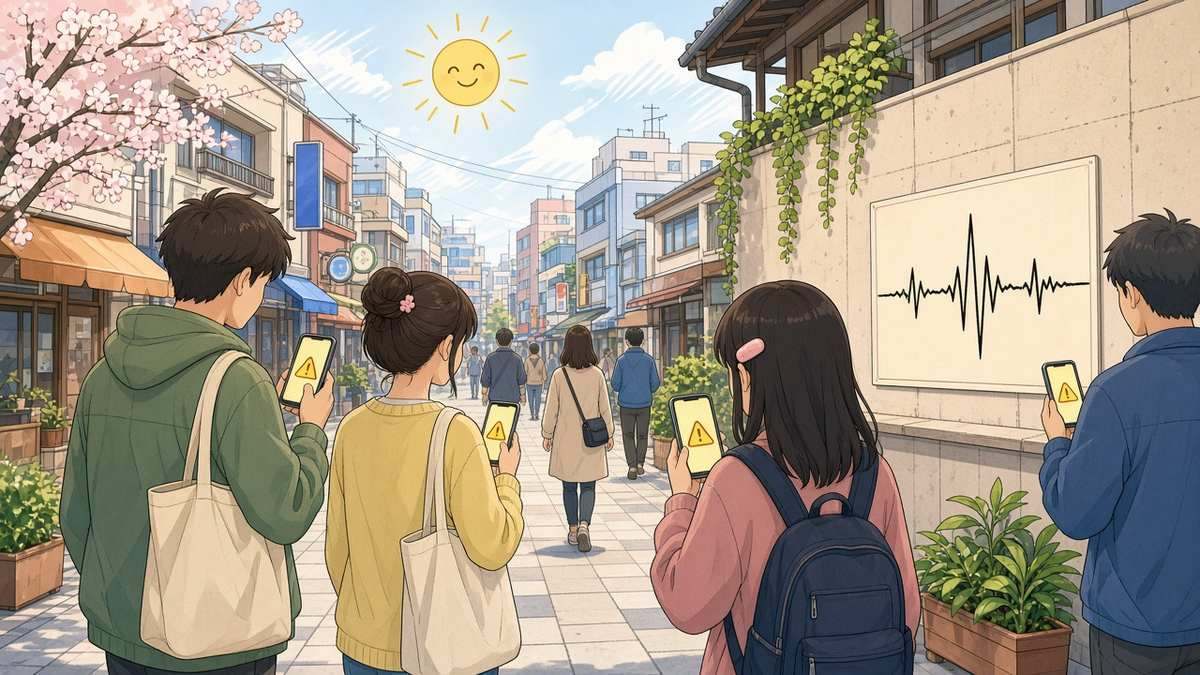
For about eight minutes on Friday, people across much of Japan, from Hokkaido down to the Tokai region, were told to brace for the strongest earthquake ever recorded. Phones shrieked, loudspeakers came to life and TV presenters urged viewers to take cover. Then a second alarm sounded, this time to call the whole thing off.
The real event was far smaller and far away. A magnitude 6.9 quake hit Russia’s Kamchatka peninsula at lunchtime Japanese time, deep underground at roughly 135 to 140 kilometres. Across Japan, seismometers picked up only the faintest movement, the kind most people never notice. Yet at 12:40 the Japan Meteorological Agency (JMA) issued an early warning, and its website listed a magnitude of 9.9, well above the 9.5 of the 1960 Chile earthquake that still holds the record. Eight minutes later, at 12:48, the agency pulled it again.
Officials later explained what went wrong. The automated system placed the epicentre off the Kuril Islands instead of near Kamchatka, then applied a formula designed for quakes close to Japan to a distant one. Two different estimated locations were also mixed up in the calculations. The agency ruled out lightning and a cyberattack. As it turns out, 9.9 is the ceiling: the software cannot publish any larger number.
It was the first time an emergency quake warning had ever been formally cancelled with a separate alarm. False alerts have happened before, notably in 2013 in the Kinki region and in July 2020, but neither came close to this scale.
Practical fallout was limited. The Tokaido Shinkansen stood still for 15 minutes after its automatic safety system kicked in, and the government said it had no reports of damage. In Kamchatka itself, residents of Petropavlovsk-Kamchatsky felt the tremor for about a minute, and some left their flats, but no tsunami threat was issued.