
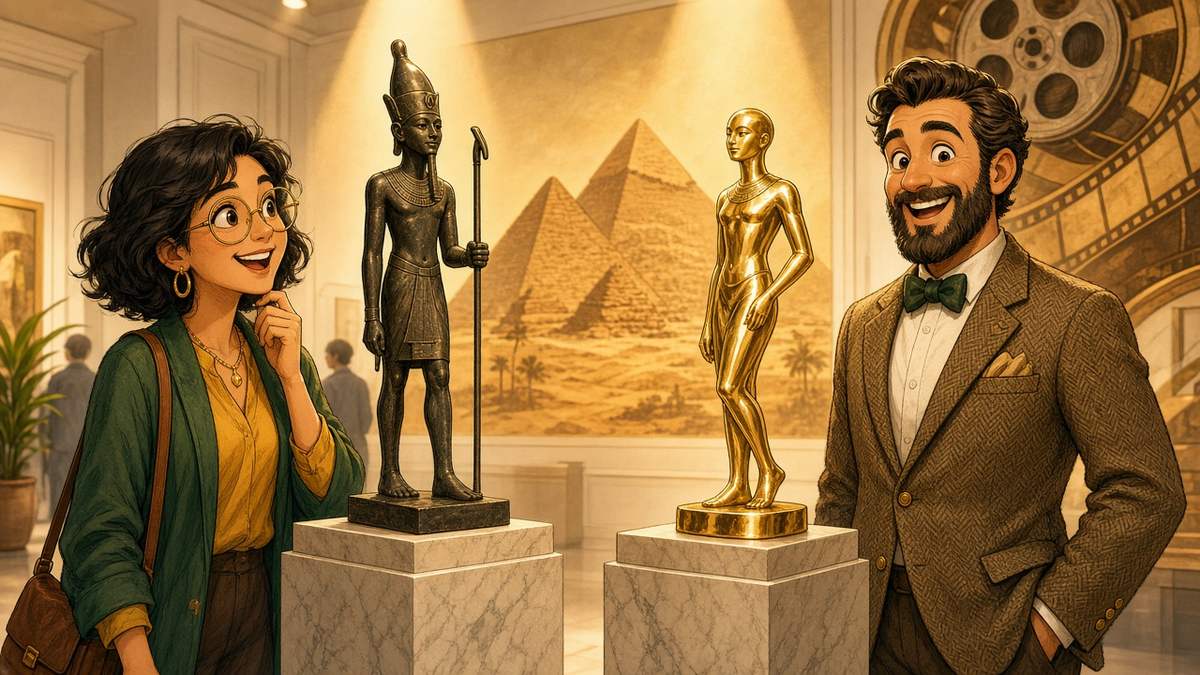
Hollywood’s most famous trophy may have an older ancestor than anyone thought. At the Frieze Masters art fair, which closed in Regent’s Park on Sunday, the British antiquities dealer Rupert Wace presented a bronze of Ptah, the Egyptian patron of craftsmen worshipped above all in Memphis. Standing just over 24 centimetres tall, the god is wrapped in a close-fitting robe, his inlaid eyes gleam with gold, and he clasps an upright sceptre in front of his body. Anyone who has seen an Oscar will notice the family resemblance.
Wace stumbled on the Hollywood thread while tracing who had owned the figure. It was made under the 26th Dynasty, between 664 and 525 BC, and in the 19th century it belonged to Lord Amherst of Hackney, whose collection in Norfolk was catalogued by a teenage Howard Carter, later famous for finding Tutankhamun. After a family fortune was embezzled, the antiquities went under the hammer in London in 1921. It was the American newspaper tycoon William Randolph Hearst who took it home.
Here the story meets the film industry. MGM art director Cedric Gibbons, who sketched the Academy Award statuette in 1928, was a friend of the press baron and a regular guest at his castle at San Simeon. He also designed sets for many films starring Hearst’s partner, Marion Davies.
Proof, though, does not exist. Gibbons died in 1960 without ever naming a model, and the Academy has long described its figure as a knight with a sword on a film reel. Wace admits as much: “We can’t prove it,” he said, while calling the match too close to be mere coincidence. The bronze found a buyer on the fair’s opening day; the price was not disclosed.
