
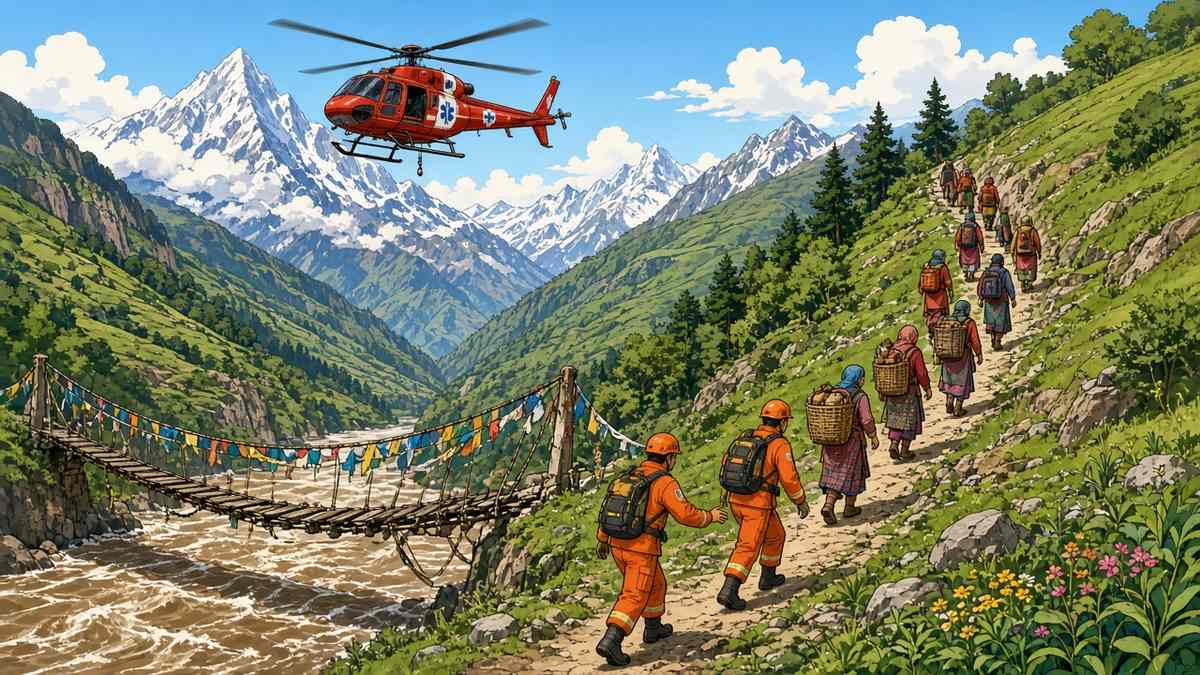
There was no rain overnight, which is what made Sunday’s disaster in central Nepal so unsettling. Shortly before dawn, villagers along the Budhi Gandaki in Gorkha district heard a deep rumbling from the side streams. Minutes later a surge of muddy water and debris tore down the valley, and families scrambled uphill in the dark, most of them leaving everything behind.
Local officials count about 35 houses lost, most of them in two small hamlets, Painyu and Bagar, which belong to Chumnubri. Six bridges were lost too, ranging from swaying footbridges to road crossings at Soti and Arughat that link communities to the outside world. Downstream at Salleri, workers’ quarters and equipment at a large hydropower construction site, planned to deliver 341 megawatts, were simply washed off the riverbank.
Roughly ten people are unaccounted for. Some were herders living in sheds beside the Ungilung stream with their yaks; others were a small party walking towards Chumling. So far nobody has been confirmed dead. Army helicopters lifted six residents out of Jagat, a village now also threatened by landslides.
Hydrologists believe a landslide had dammed a tributary upstream. When that temporary barrier failed, the trapped water rushed downhill all at once. Pictures taken from orbit reveal fresh, bare ground where a hillside gave way.
Prime Minister Balen Shah sent troops by road and by air, and helicopters are flying in relief supplies. Home Minister Sudan Gurung urged people in a long list of riverside settlements to head for higher ground without delay. The river level keeps rising and falling, so flood forecasters have put communities on the Trishuli as far as Benighat on their highest alert.
Memories of August make the warnings hard to ignore. A catastrophic flood on the Bhote Koshi in Rasuwa district at the end of that month left thousands of people dead or missing.
