
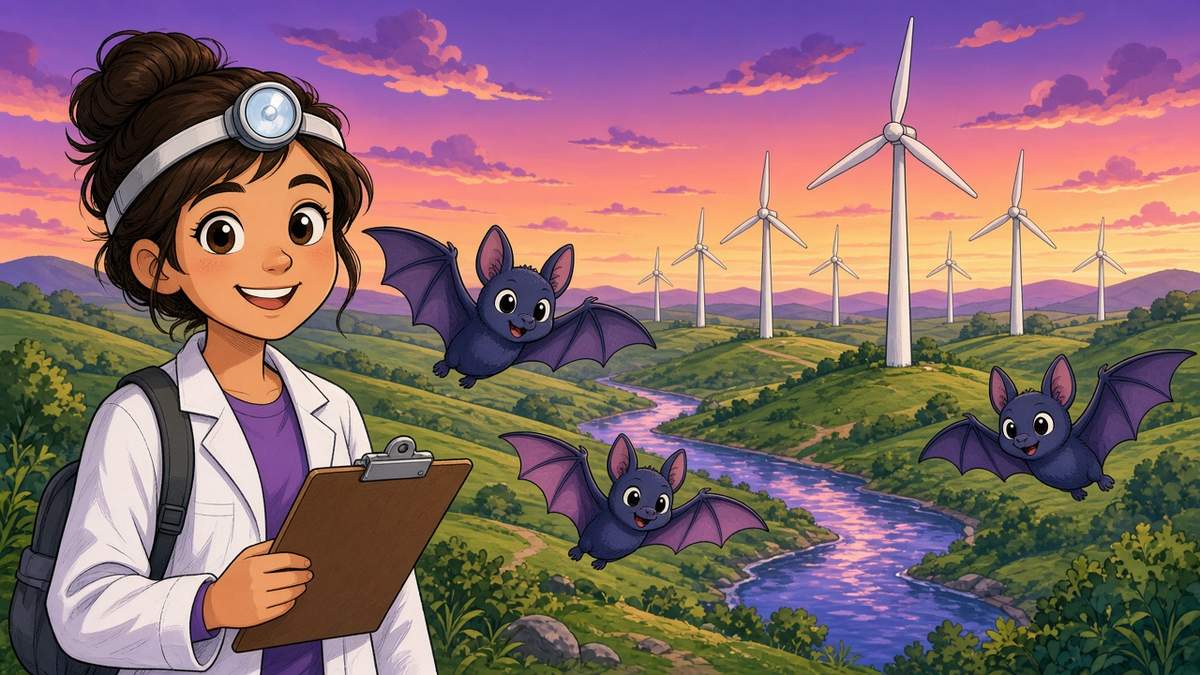
Clean power comes with a hidden casualty list. A new analysis led by the US Geological Survey estimates that onshore wind facilities in the United States killed about 18.7 million bats between 1981 and 2024, a figure well above earlier assumptions and possibly on the same scale as the losses caused by white-nose syndrome, the fungal disease that has devastated the continent’s bats.
Counting dead bats is harder than it sounds. Operators search their sites in different ways, scavengers carry carcasses off and tall vegetation hides others. To get around this, the team pooled 499 monitoring reports from 277 facilities and built a statistical model that also estimates deaths at farms nobody checked. The uncertainty is wide, roughly 13 to 26 million, but the trend is unmistakable. Around twenty years ago the yearly toll was near 100,000; since 2021 it has topped 1.5 million, tracking the rapid growth of wind energy.
The victims are mostly migratory species that roost in trees rather than caves. By the model’s reckoning, some 6.7 million of the dead were hoary bats; the eastern red bat lost about 5.8 million and the silver-haired bat roughly 3.4 million. Because these are not the species hit hardest by white-nose syndrome, the authors writing in PNAS warn that the two threats could compound each other.
Scientists still debate why bats fly into turbines at all. They may be drawn by the noise, mistake the towers for trees or simply fail to sense the blades. The study is clearer on location and design: turbines with larger rotors, blades that sweep closer to the ground, and sites near rivers, where bats feed and navigate, were linked to more deaths.
Europe offers a hint of what could work. Research on 141 European wind farms found that pausing turbines during conditions ideal for bat flight can cut fatalities by more than 80 percent, and Germany has required such curtailment rules since around 2010.
