
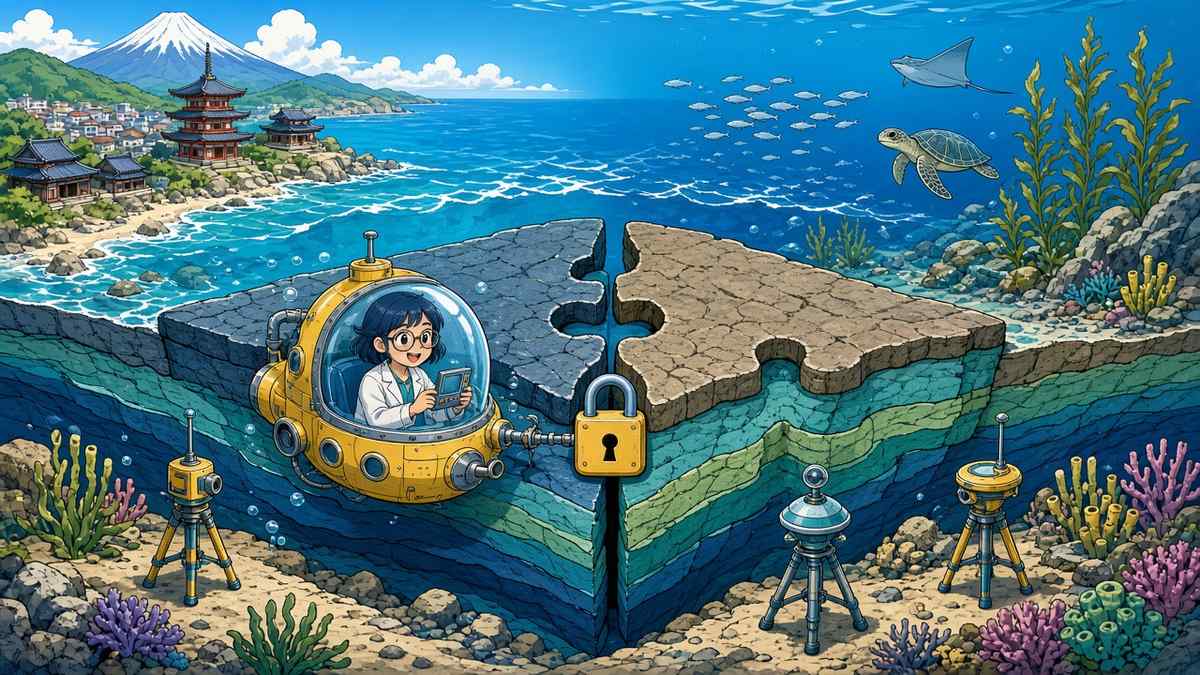
The stretch of seabed that unleashed Japan’s catastrophic 2011 earthquake is storing up energy once more. A team led by Fumiaki Tomita of Tohoku University reports in the journal Science that the plate boundary under the Japan Trench has gripped tight again, much as it did before the magnitude 9.0 shock.
After a great quake, the two sides of a fault usually keep creeping past each other for years, a process known as afterslip. The new measurements show that this slow movement off northeastern Japan has all but ended. With the creep gone, the Pacific plate and the plate above it are stuck together again, so stress is building where it was released 15 years ago.
To reach that conclusion, the researchers combined 14 years of readings from instruments on the ocean floor with land-based observations, small repeating earthquakes and computer models. The Japan Agency for Marine-Earth Science and Technology took part in the work. Deformation in the region appears to have settled down from around 2021.
The authors stress that their findings are not a forecast. There is no date and no claim that a rupture is near. Giant quakes along this trench have typically come centuries apart, yet the paper notes that a relocked fault “can come early,” pointing to the magnitude 8.8 Kamchatka earthquake of 2025.
The stakes are well known. The 2011 earthquake and tsunami left some 20,000 people dead or missing, triggered the Fukushima Daiichi nuclear disaster and sent waves across the Pacific to Hawaii and the US West Coast.
For the scientists, the main lesson is practical: old averages between big quakes are a poor guide on their own. Keeping a close watch on the seafloor, and keeping coastal defences and evacuation plans up to date, matters more than ever.
