
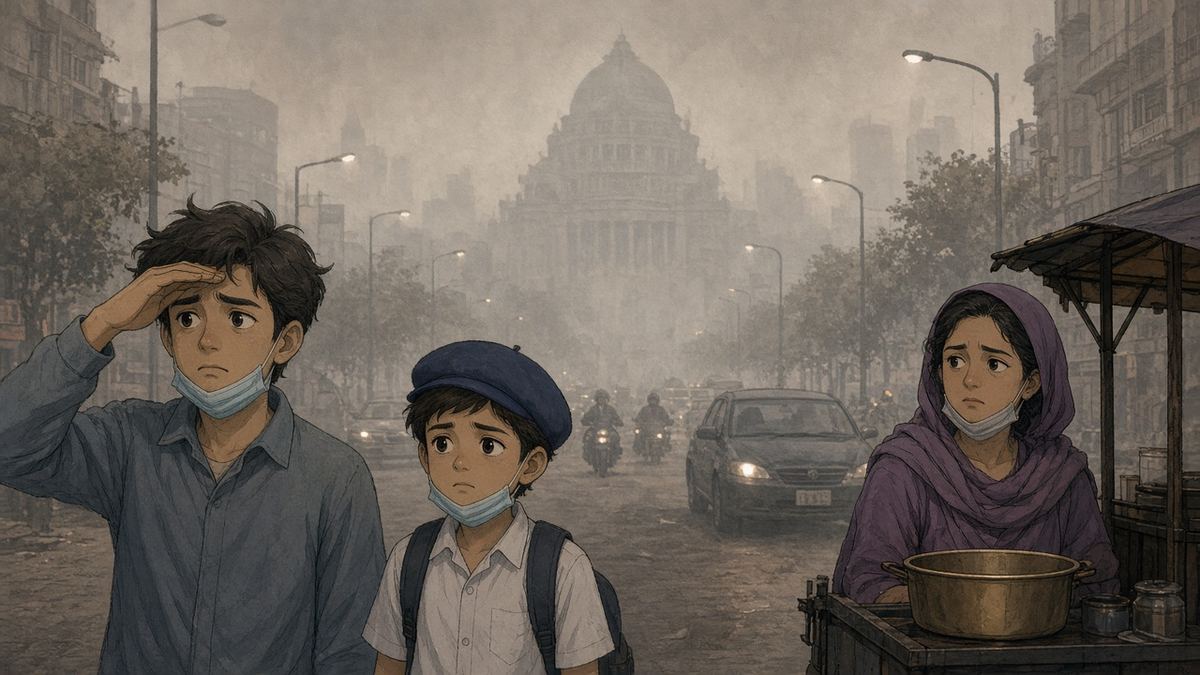
For the roughly 20 million people of India’s capital, Friday began in a brown haze thick enough to swallow street lights. By the morning count of IQAir, the Swiss air monitoring company, Delhi had the dirtiest air of any major city on the planet, pushing Lahore across the border in Pakistan out of first place.
On IQAir’s scale the capital scored 334, deep inside the range labelled hazardous, whereas readings of 50 or below count as clean. The national pollution watchdog, working with its own method, logged 403 at nine in the morning and rated the air severe, with more than half of Delhi’s monitoring stations in that category and several readings above 450. Conditions eased somewhat as the day went on.
The readings have climbed almost every day since Diwali last Sunday. The country’s top court had permitted only approved low-emission fireworks within fixed time slots, yet a Delhi-based environmental research centre found fine particle levels in the week before the festival nearly twice as high as a year earlier.
Festival smoke is only part of the story. Each winter, cold and stagnant air settles over northern India and Pakistan and holds down exhaust, dust from building sites and the smoke of stubble fires in the fields. Official estimates blame vehicles for nearly a quarter of the winter haze and burnt plant matter for about a fifth. A 2024 study tied roughly 33,000 deaths annually in ten Indian cities, Delhi among them, to brief surges of fine dust.
Lahore’s relief is relative. The city dropped to seventh in the ranking, but a recent Pakistani report put its average fine particle concentration at roughly eight times what WHO recommends and counted nearly 19,000 fires across Punjab, most of them in fields.
