
For almost thirty years, a small Scottish fossil nicknamed Lizzie carried a grand title: one of the earliest reptiles on Earth. That reputation has now collapsed. Researchers who looked inside the specimen, which is around 345 million years old, discovered gills and a mouth that belongs more to a fish than to any lizard.
Westlothiana lizziae was dug up in 1984, and it has always been hard to read. The skeleton lies squashed between two slabs of rock, so researchers worked mostly from what showed on the surface. That was impressive enough: four limbs, five toes on each foot and digits ending in what looked like claws. Many took this as proof that Lizzie walked on land and sat near the root of the amniotes, the lineage behind reptiles, birds and mammals.
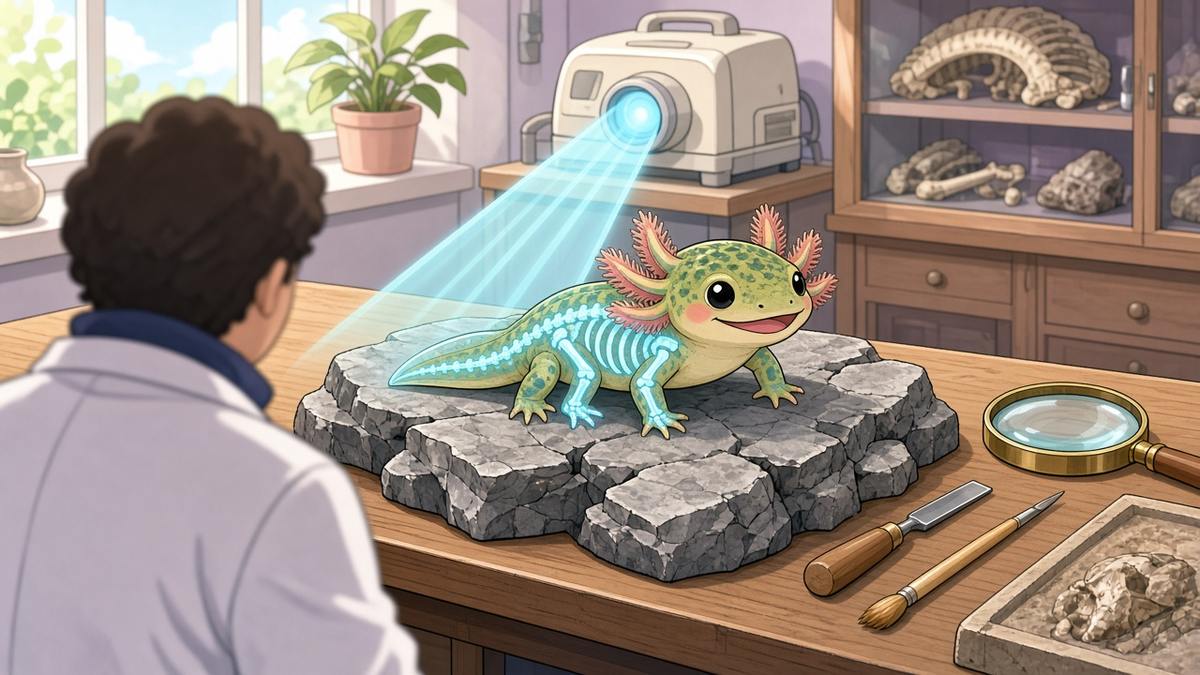
Paleontologists from New York’s natural history museum and from Oxford brought both slabs to a particle accelerator facility in Grenoble, France. Its powerful X-rays allowed them to rebuild the hidden anatomy in three dimensions. What emerged was an old-fashioned skull, gill supports made of bone and a mouth roof studded with countless minute teeth. The verdict, published in Nature, is that Lizzie spent her life in water or at its edge.
Co-lead author Ben Igielman summed it up in one line: “Looks can be deceiving.” Curator Roger Benson called the result “a big surprise”, because it shows that several reptile-like traits were already present in the common ancestor of amphibians and reptiles, assembled bit by bit in creatures that still swam.
There is a knock-on effect for one of paleontology’s livelier arguments. Some Devonian trackways with claw marks, older than 359 million years, have been used to argue for very early amniotes. If animals like Lizzie also had claws, those prints prove much less. Their makers may simply have been more primitive four-legged relatives.
