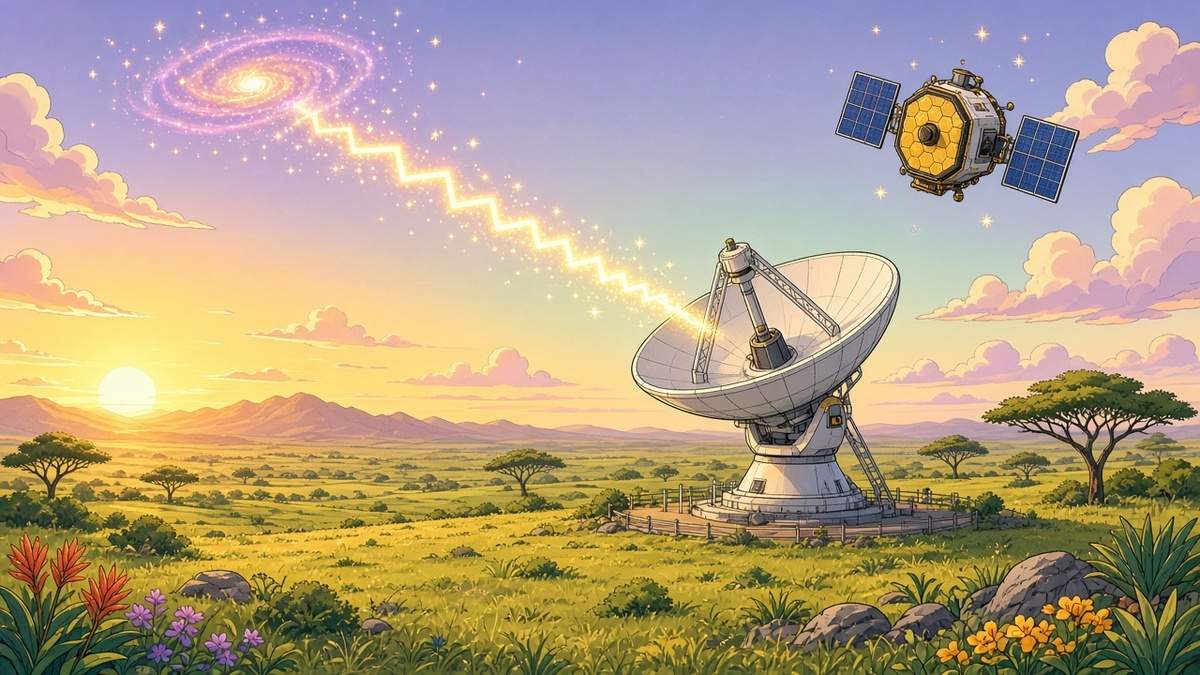
A flash of radio waves that lasted only milliseconds has given astronomers a new clue about what produces fast radio bursts. The signal, catalogued as FRB 20240304B, came from a small, young galaxy still busily making stars, the kind of place where freshly born magnetars, extremely magnetic neutron stars, are expected to form.
The burst left its source when the universe was roughly 3 billion years old, about a fifth of its present age. Its radio waves, in other words, have been on the road for 10.6 billion years. According to ESA, that more than doubles the distance record for a burst whose home galaxy has been identified.
The detection dates back to 4 March 2024, when the MeerKAT array in South Africa, running the MeerTRAP real-time system, caught the signal. Its lower frequencies arrived a little later than the higher ones. That smearing grows with the amount of ionised gas a signal crosses, and here it hinted at an enormous distance.
Confirming it proved hard. Even the Keck telescopes in Hawaii saw nothing at the position. Only the James Webb Space Telescope revealed a faint, clumpy galaxy there, and its NIRSpec instrument fixed the redshift at 2.148. The galaxy holds only about 10 million solar masses and very few heavy elements.
That matters for the theory. If bursts came mainly from merging neutron stars, they would need long delays and older galaxies. A young host fits better with magnetars, which can switch on soon after a massive star explodes. Sydney astronomers Manisha Caleb and Themiya Nanayakkara were among the team that published its results in Science.
There is a bonus as well. On its way, the signal recorded the gas and magnetic fields it passed, giving researchers a probe of roughly 80 percent of cosmic history.