
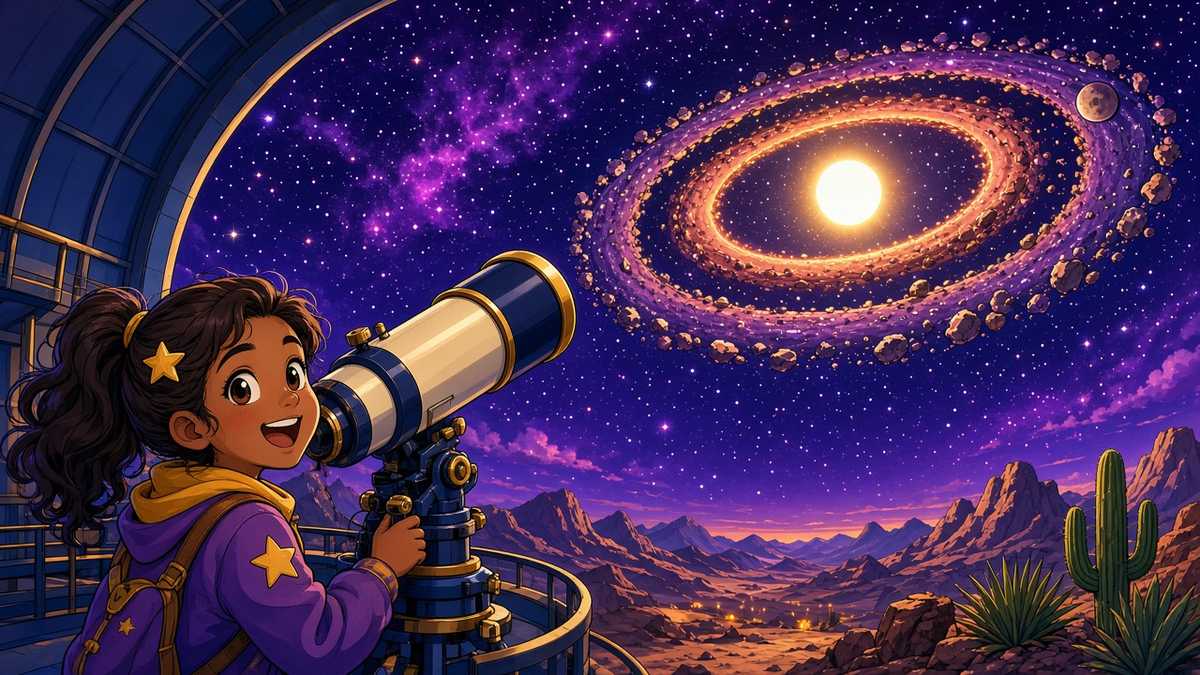
Astronomers have spotted something around a burnt-out star that nobody had seen before: not one band of planetary wreckage but two, nested inside each other with an empty gap between them. The star, a white dwarf catalogued as WD J1328−1450 about 1,600 light years away, is described this week in Nature Astronomy by a team led by Nicola Pietro Gentile Fusillo of the University of Trieste with colleagues at Warwick.
When a star like our Sun runs dry, only a compact, glowing ember called a white dwarf is left. On the way there it swells, swallowing close-in planets, and any rocky survivors can be ground into a disc of debris. Each of the 21 similar gas discs known so far leaves the same two-peaked fingerprint in its light. This star broke the rule. Light gathered by X-Shooter, a spectrograph mounted on ESO’s giant VLT telescope high in the Chilean desert, showed four peaks, which is how two separate rings reveal themselves.
Measured from the star, the close ring sits between some 100,000 and 240,000 km, while its wider partner begins near 375,000 km and stretches past 1.3 million. Repeat observations from 2021 to 2023 found the pattern holding steady. The team’s explanation is that two leftover bodies, each circling inside its own ring, keep the structure in shape. Nobody can measure them directly, but simulations suggest a modest rock of a few kilometres closer in and, farther out, an object that might rival Pluto or even the Moon.
The chemistry adds a twist. Calcium, oxygen, magnesium and iron point to rocky material like Earth’s, yet magnesium is plentiful only in the inner ring. That could mean two different former planets, or the crust and core of a single shattered world.
The lead author compares the work to reconstructing a demolished building from the dust it left behind: the bodies themselves stay invisible, and only the shape and makeup of the gas betray them. The finding carries a personal note for us: billions of years from now the Sun will also become a white dwarf, a transition that Earth is unlikely to survive.
