
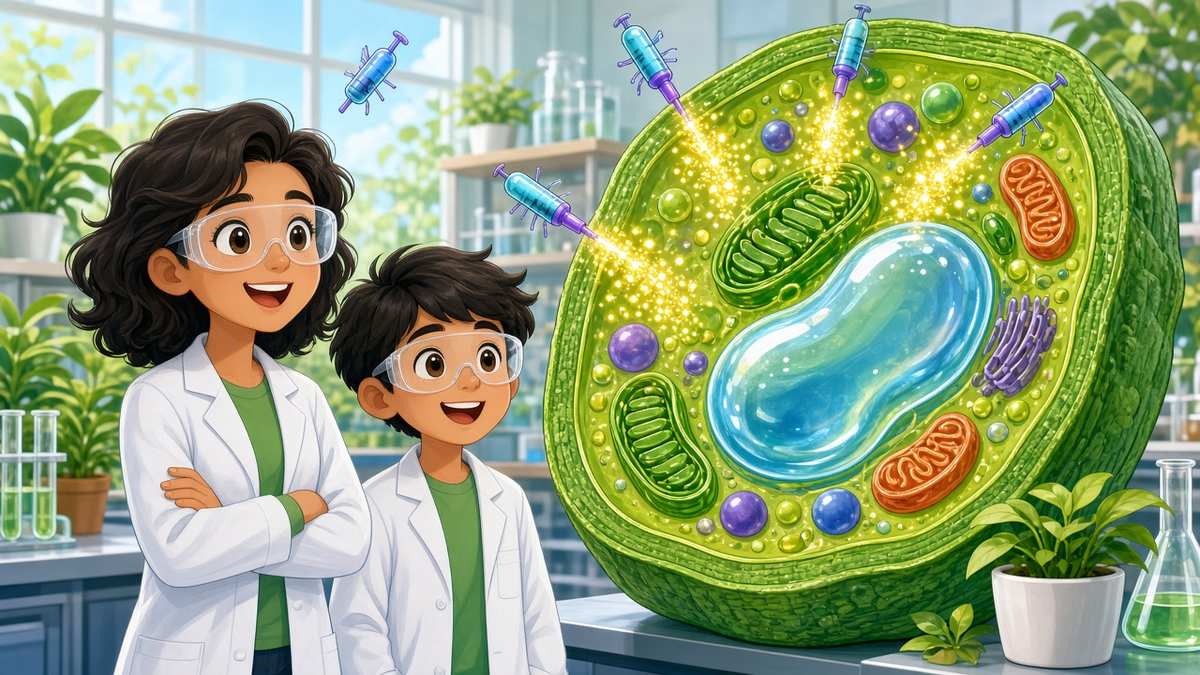
Getting anything useful inside a plant cell is notoriously hard. A tough wall and a membrane guard each one, keeping out the very proteins scientists would like to deliver. Engineers at Caltech think they have found a way through, by borrowing a weapon from the microbial world.
Some bacteria of the genus Photorhabdus release microscopic injection devices that attack insects. Fibres on the device grip a victim cell, an outer sheath snaps shut and a hollow tube is rammed through the membrane to unload toxins. Gözde Demirer’s group at Caltech rebuilt this machinery so that it hunts plant cells instead, fitting it with a short peptide that latches onto a receptor called FLS2.
Their results, reported in Nature Nanotechnology, are striking. In thale cress, the modified syringes carried an enzyme that rearranges DNA into as many as 16 percent of leaf cells. In plants engineered to display extra FLS2, that figure climbed to around three in four. Without the receptor, delivery failed altogether, showing the system goes only where it is told. The team also shipped a larger tool, the R2 genome editor, into leaves of Nicotiana benthamiana, a relative of tobacco, where it stitched a test gene into the plant’s DNA at a chosen spot.
The appeal over many existing techniques is that the finished protein arrives ready to work, rather than as DNA instructions the cell must read. That lowers the chance of stray foreign genetic material lingering in the plant. The researchers caution that field use is still some way off. In the long run, they hope to aim the syringes at particular cell types, probing how single cells shape growth, immunity and stress tolerance, and ultimately helping to breed hardier crops.
