
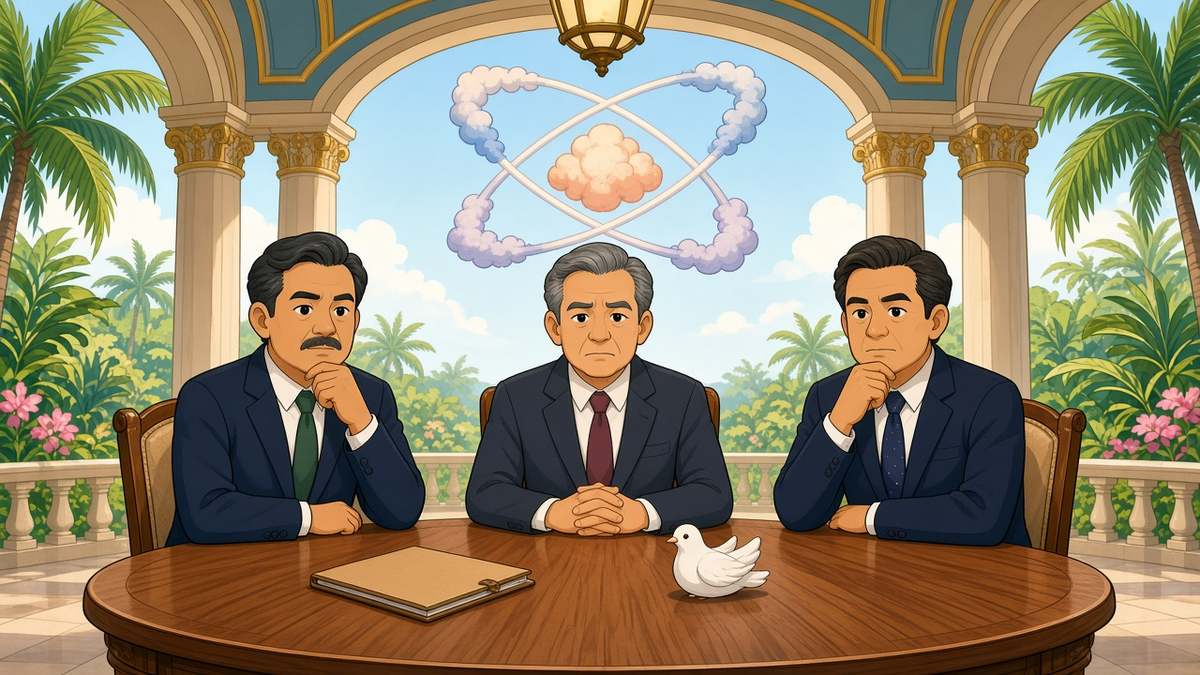
For the first time ever, the leaders of the United States, China and Russia sat down together as a trio. The setting was a villa in Shenzhen on the margins of the Asia-Pacific summit, the table was round, and the talks overran the single hour the Kremlin had announced. The written outcome, however, turned out to be remarkably slim.
Chinese state agency Xinhua published what it called a “Declaration toward Peace” on Thursday. Its four short points commit the three permanent Security Council members to reforming the United Nations, to raising output of refined fuel products and keeping energy flowing, and to holding a dialogue on cutting nuclear dangers and stopping the spread of atomic weapons. A further clause stands out: it calls the protection of officeholders from prosecution a matter of the highest importance and warns the International Criminal Court not to overstep. That court has had an arrest warrant out for Vladimir Putin since 2023, and Donald Trump called it “out of control” during the meeting.
Trump framed the gathering as history in the making and argued that the three biggest nuclear powers were “uniquely positioned” to discuss shrinking their arsenals. Xi Jinping went further on paper, saying such weapons should eventually be banned and destroyed altogether, even though Beijing has long refused to join arms talks with Washington and Moscow. The declaration contains no numbers, no verification and no treaty.
On the war in Europe, the text says nothing. Putin spoke of shared interests in settling regional conflicts, while Xi avoided the war entirely. With neither Kyiv nor any European capital in the room, smaller states watched uneasily, and some commentators reached for comparisons with Yalta in 1945.
The more practical diplomacy may happen elsewhere. Jared Kushner said he and special envoy Steve Witkoff would fly to Berlin to consult Volodymyr Zelensky and European leaders, a sign that any real movement on the war will need people who were absent from Shenzhen.
