
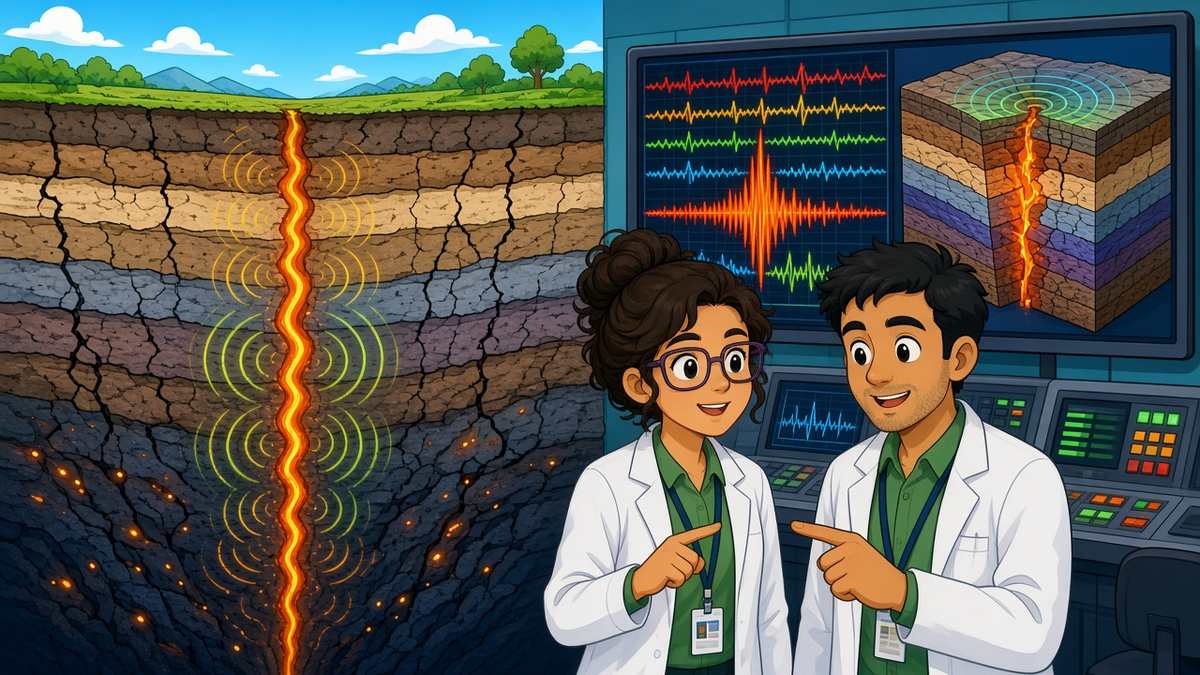
Seismologists have long known a basic rule of the shaking Earth: tiny tremors are everywhere, moderate ones are rarer, and truly destructive ones are rare indeed. Describing that pattern is easy. Explaining the physics behind it has proved far harder. A University of Michigan team now argues that much of the answer lies not on the fault itself, but in the battered rock surrounding it.
Most simulations treat a fault as a single sliding surface. The new model, built by Peng Zhai during his doctoral research and led by geophysicist Yihe Huang, adds the fractured belt of stone on either side. Every rupture damages that zone further, deforming it permanently, and between events the cracks slowly heal again.
Huang points to California’s San Andreas system as an example. Seen from above, she said, it looks less like a clean line than a broad field of broken rock stretching hundreds of metres or even kilometres outward, a complication modellers usually leave out because it makes the maths much harder.
Zhai and Huang simulated the entire seismic cycle, from the gradual loading of stress through the onset and spread of a rupture to the recovery of the rock, across spans from a few seconds up to several hundred years. Their findings, which appear in the journal Science Advances, reproduce three classic features within one physical picture: weak quakes are far more common than strong ones, events of very different size release similar stress per unit of area, and the energy required to break the fault grows as quakes get bigger.
In effect, the damaged margin soaks up energy and halts many ruptures early. Zhai stresses the practical stakes: reliable forecasts, he argued, require a full grasp of how stress acts on a fault and how badly the rock around it has been broken. The research was funded by the US National Science Foundation.
