
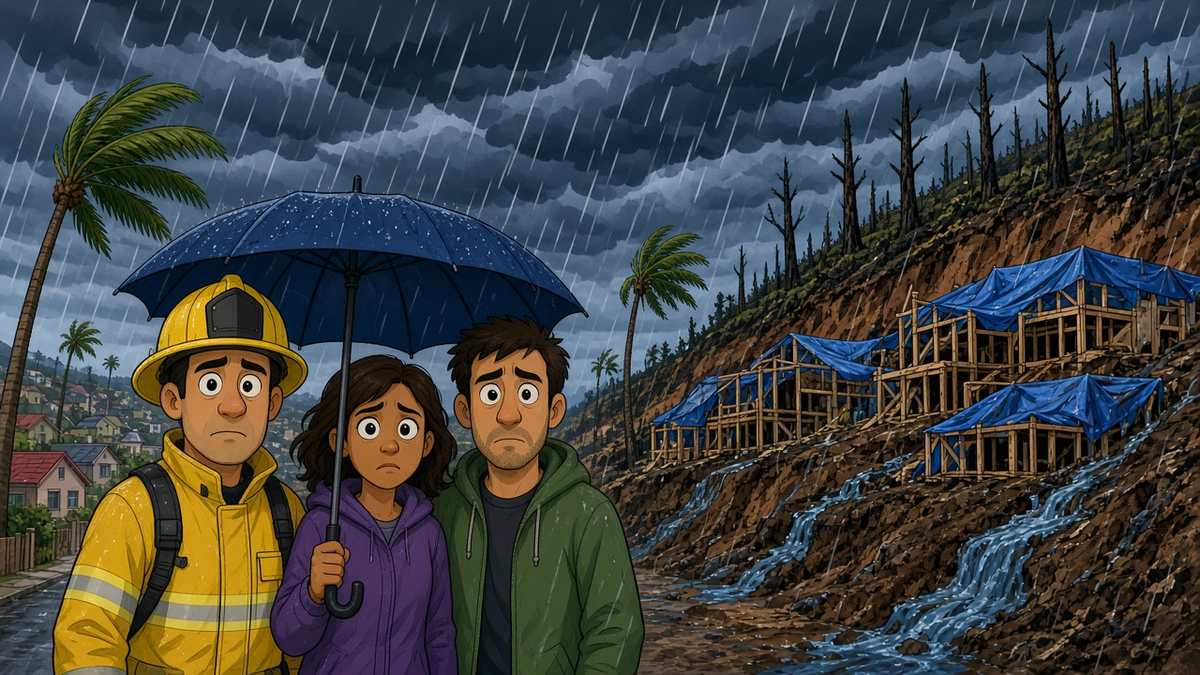
The season’s first atmospheric river swept into Southern California on Thursday, and the people watching it most anxiously live below hillsides stripped bare by recent wildfires. On such slopes, once rain exceeds roughly half an inch per hour it can loosen mud, ash and boulders and send them downhill.
Since Wednesday evening, and until Friday morning, residents of several fire-scarred districts have been told to be ready to go. The list includes the Palisades, Sunset and Hurst burn areas inside the city, the hills above Altadena scorched by the Eaton blaze, the zone around Castaic burned in the Canyon fire, and the Kenneth fire scar by Calabasas. A warning is a signal to get ready rather than to leave, and police officers phoned owners of the most exposed homes.
The storm had already shown its strength on the way south. Trees came down in San Luis Obispo and Summerland during the night, rocks tumbled onto roads, and part of the coastal Highway 1 near Santa Barbara had to be shut. On Highway 101, one driver got stuck when water covered the road. Weather service staff in Oxnard measured bursts above an inch per hour and put out a string of flash flood alerts; Burbank, Glendale and Santa Clarita were under one until midday.
Totals of one to two inches looked likely along the coast and in the valleys, while mountainsides facing south could collect as much as five. Sacramento switched on its emergency operations hub and staged engines and water-rescue teams near the neighbourhoods judged most exposed.
In Pacific Palisades, where many lots still show only wooden framing, crews spent Wednesday wrapping houses and bare dirt in plastic sheeting. One couple told a local TV station they had not known about the warning until their daughter called, and that the forecast felt “very triggering” after the fires.
The timing is no surprise to climate scientists. An unusually powerful El Niño has heated the ocean and makes a soggy winter more likely. Northern California got an early taste on Wednesday, when cars, delivery vans and even driverless taxis sat stranded in San Francisco floodwater.
