
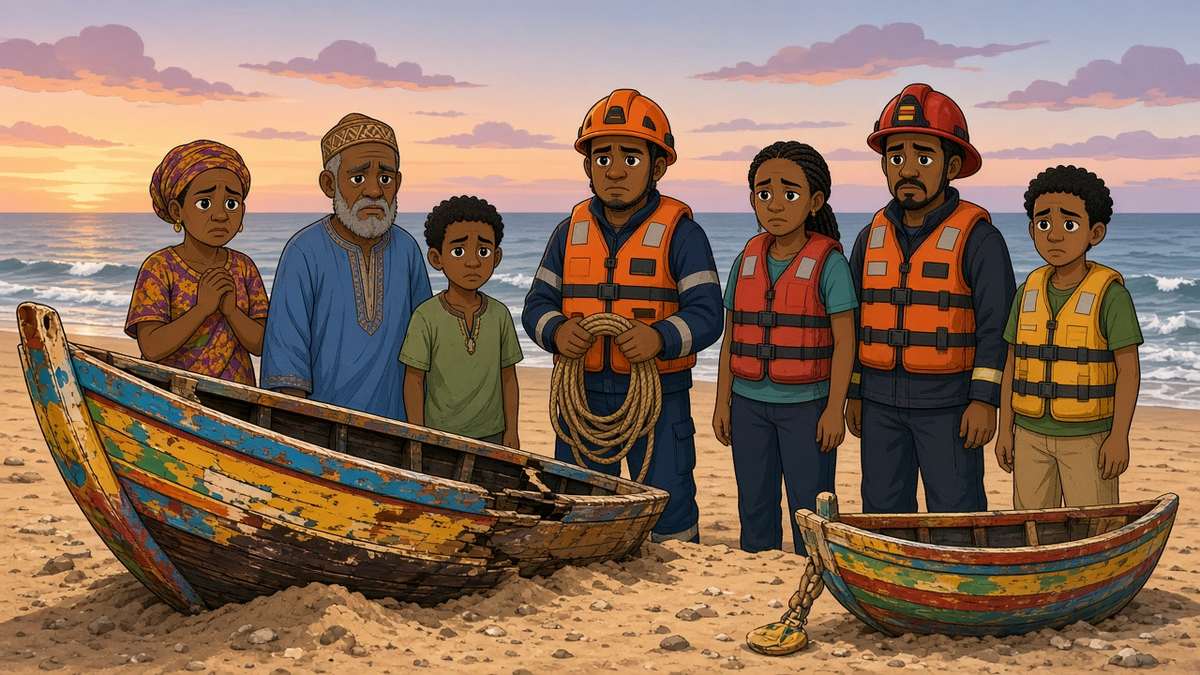
For the second time in less than a fortnight, Senegal’s Atlantic coast has become the scene of a migrant disaster. A wooden pirogue carrying people hoping to reach Europe broke apart on rocks off Yenne, a fishing village south of Dakar, in the early hours of Wednesday. By Thursday rescuers had reportedly recovered four bodies, and dozens of passengers remain unaccounted for.
How many people were on board is still unclear. One man who survived told police investigators that roughly a hundred travellers had crowded aboard, among them five women; a municipal source, by contrast, estimated half that number. In his account, the vessel struck a rock while passengers were being moved from small fishing boats onto a larger craft.
Residents describe a night of horror. Oumar Sow, who represents the village chief, said the accident happened at around 2am and that screams from the boat “could be heard” on the beach. The battered hull later washed ashore; among the debris were water sachets, phones, identity papers and the school enrolment form of a teenager from Kabrousse in the far south.
Local officials say Yenne has turned into a departure point where smugglers recruit boat pilots. Earlier this month at least 39 people drowned off Thieppe in the north-west, one of the worst such accidents in the country’s history.
President Bassirou Diomaye Faye voiced alarm in cabinet over a renewed surge in irregular departures and asked the interior ministry for a report on causes and countermeasures. Within just two days earlier this week, naval crews brought more than 1,400 people back to land, according to the military.
The pressure shows at the other end of the route. The Canary Islands have seen record arrivals in November, and the UN refugee agency counts nearly 600 deaths on the West African corridor this year. Rights groups fear the true toll is far higher, because many boats vanish without a trace.
