
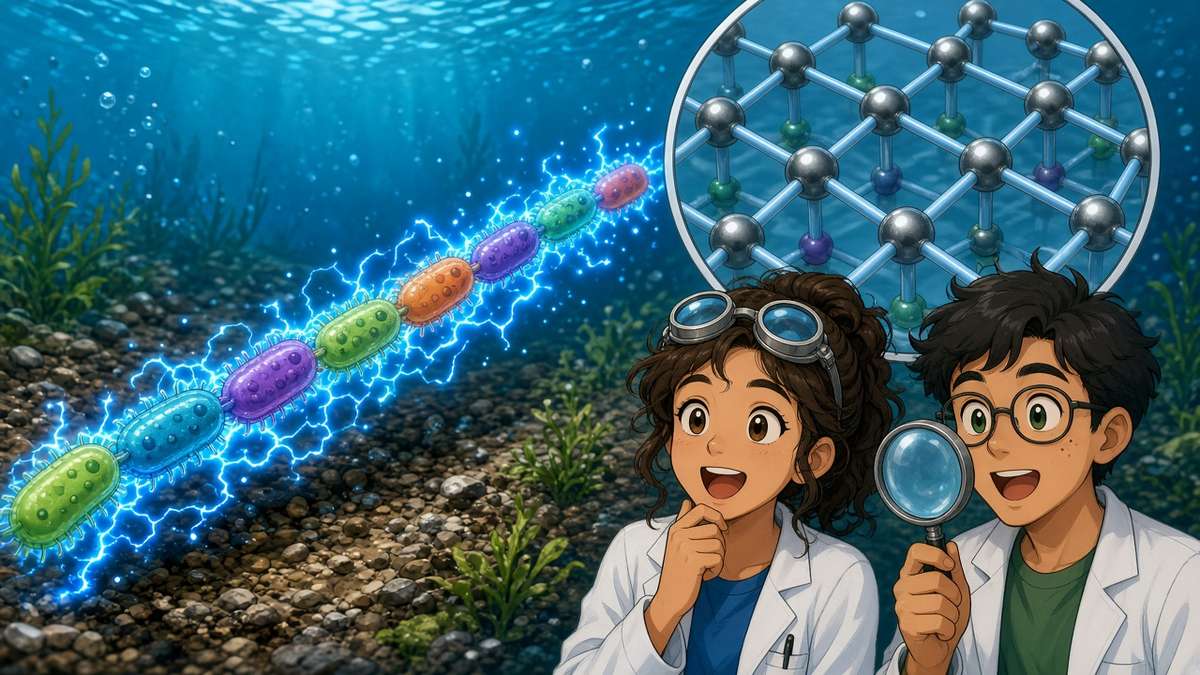
Chemists who pioneered so-called MOFs took home last year’s chemistry Nobel, and such crystals are normally regarded as a purely human invention. It now appears a humble microbe got there first. A team headed by scientists in Antwerp, Belgium, reports that cable bacteria build a MOF of their own, a first for any form of life.
A MOF works a bit like scaffolding: metal ions sit at the joints, while organic molecules serve as the poles linking them into a regular, repeating lattice. Swap the parts and you change the properties, which is why these materials are explored for trapping carbon dioxide, speeding up reactions and carrying electric current.
Cable bacteria are odd creatures in any case. They live in the sediment beneath rivers, lakes and coastal seas, where thousands of cells line up end to end into filaments centimetres long. Current flows along each filament inside a few dozen fine threads, which are about 50 nanometres thick and lie side by side. Since scientists first described the organisms some 15 years ago, nobody could explain what made those fibres conduct so well.
To find out, the team combined nano-scale X-ray imaging at the ESRF synchrotron in France and Diamond Light Source in the UK with spectroscopy, microscopy and computer modelling. Inside the fibres they found ribbons rich in nickel and sulphur, made of identical nickel-dithiolene building blocks that stack into an ordered lattice. Few synthetic MOFs carry current anywhere near as well.
Lead author Filip Meysman said his group was stunned to find that evolution had arrived at the same concept as the prize-winning chemists. The study, published in Nature Communications, could point the way to electronics that are cheaper, greener and inspired by biology.
